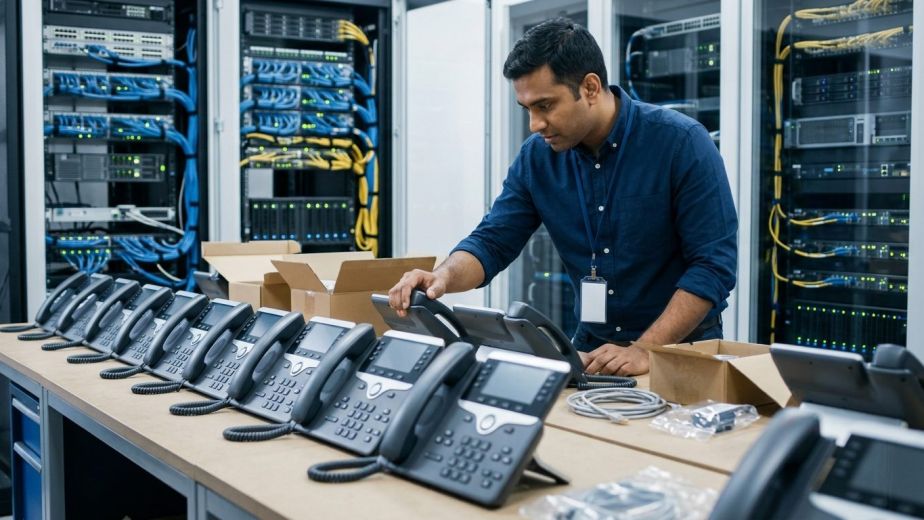
Implementing rigorous enterprise VoIP security is essential for protecting modern organisations from service disruptions, eavesdropping, and catastrophic financial theft. As corporate voice environments migrate from isolated copper circuits to internet-facing Session Initiation Protocol (SIP) pipelines, telephony infrastructure becomes vulnerable to the same automated exploits targeting corporate web applications. This guide details practical architectural controls to secure your PBX systems, SIP trunks, and voice networks against sophisticated cyber threats.
Key takeaways
- Deploy dedicated Session Border Controllers to isolate internal telephony servers from public IP exposure.
- Enforce strict IP allowlisting on all SIP signalling ports (UDP/TCP/TLS 5060 and 5061) to block automated botnet probes.
- Mandate cryptographic hygiene using SIP-TLS for signalling and SRTP for encrypted voice transport.
- Isolate voice traffic on dedicated VLANs with strict firewall rules preventing lateral movement from user subnets.
- Establish real-time call-rate heuristics and carrier-level credit caps to eliminate toll fraud exposure.
The Anatomy of Modern Telephony Threats
Corporate telephony has evolved rapidly over recent years. Legacy PBX setups relied on physical isolation, but hybrid working has distributed voice endpoints across public networks and home offices. Consequently, threat actors now deploy automated scanners to target exposed SIP interfaces on business networks.
The most financially damaging threat remains International Revenue Sharing Fraud (IRSF), commonly called toll fraud. Cybercriminals compromise SIP credentials or exploit unauthenticated PBX dial plans during weekends or public holidays. Once inside, they route thousands of concurrent, automated calls to premium-rate overseas numbers that they control. Victims routinely face substantial carrier invoices accrued in mere hours before anyone notices.
Beyond toll fraud, unhardened systems face brute-force credential stuffing against extension registrations. Attackers can hijack internal extensions to conduct voice phishing (vishing) campaigns against employees, partners, or customers. Furthermore, unencrypted RTP media streams travelling across public networks expose sensitive corporate discussions, executive briefings, and customer records to passive eavesdropping.
Perimeter Defence: Session Border Controller Architecture
Securing voice infrastructure requires a dedicated perimeter device designed specifically for real-time media. Standard network firewalls inspect stateful traffic, but they often struggle with the dynamic port negotiation inherent to SIP and RTP streams. Implementing a resilient telephony solutions strategy requires a dedicated voice firewall.
A robust session border controller architecture acts as an authoritative proxy between untrusted outside connections and your private PBX deployment. Whether you run systems like 3CX business communications or on-premises platforms, an SBC safeguards voice performance while inspecting real-time packets.
Crucially, SBCs provide topology hiding. They strip internal IP addresses, routing headers, and server signatures from outgoing SIP packets. External carriers and remote endpoints only see the public-facing interface of the SBC. The internal architecture of your corporate PBX remains completely invisible to port scanners.
SBCs also handle deep packet inspection (DPI) of SIP headers to discard malformed requests designed to cause buffer overflows. They regulate Network Address Translation (NAT) traversal seamlessly. This eliminates the dangerous practice of opening massive, static ranges of UDP ports directly to your internal core switch.
SIP Trunk Security Best Practices and Access Control
The golden rule of voice perimeter defence is straightforward: never expose default SIP signalling ports (5060/5061) to the open internet without identity verification. Automated reconnaissance bots constantly probe public IPv4 ranges for SIP responses to build target lists for dictionary attacks.
Adhering to proven sip trunk security best practices starts with absolute interface lockdown. As reported by CyberSecurityNews, platforms like Shopify now mandate IP allowlisting for public apps to block unauthorized admin API access. Voice engineering demands the exact same principle. Configure edge firewalls to accept SIP signalling exclusively from the verified public IP blocks supplied by your telecom provider.
When provisioning external extensions for remote staff, avoid open registration regimes. Implement zero-trust network access (ZTNA) or persistent VPN tunnels for remote softphones. Alternatively, enforce authentication through an edge-placed SBC running strict rate-limiting policies. If an external IP address fails SIP authentication three consecutive times, your perimeter firewall must drop all further packets from that source immediately.
Cryptographic Hardening: SRTP and TLS VoIP Encryption
VoIP traffic consists of two distinct data streams: signalling and media. Signalling establishes, modifies, and terminates the session, while media carries the spoken audio. Leaving either component unencrypted invites packet interception, credential harvesting, and man-in-the-middle manipulation.
Comprehensive enterprise voip security mandates end-to-end cryptographic protection using modern transport standards. SIP over Transport Layer Security (TLS) encrypts the signalling layer. It wraps call metadata, user credentials, and dialed numbers in an encrypted tunnel, making header inspection impossible for external eavesdroppers.
To protect spoken audio, teams must enforce Secure Real-Time Transport Protocol (SRTP). Operating under specifications defined by the Internet Engineering Task Force (IETF), SRTP encrypts voice payloads using AES-128 or AES-256 cipher suites. Even if an attacker taps a switch port or intercepts traffic on public Wi-Fi, the resulting capture yields only unintelligible static.
Deploying cryptographic controls across physical desk phones from manufacturers like Yealink or Fanvil requires careful certificate lifecycle management. IT administrators should automate certificate delivery via secure auto-provisioning protocols. Always disable legacy, insecure transport options like cleartext UDP and unencrypted RTP across the entire PBX configuration.
Internal Network Isolation: VoIP VLAN Segmentation
Security perimeters do not end at the external firewall. Many of the most severe enterprise breaches originate internally when a compromised laptop or malware infection moves laterally across the local area network. Placing VoIP endpoints on the same broadcast domain as general office computers creates substantial risk.
Implementing structured voip vlan segmentation ensures that voice packets and administrative PBX interfaces remain isolated from everyday user endpoints. Leverage IEEE 802.1Q tagging alongside Link Layer Discovery Protocol – Media Endpoint Discovery (LLDP-MED) or Cisco Discovery Protocol (CDP). When a desk phone connects to an access switch, the switch automatically assigns it to an isolated voice VLAN.
Enforce strict access control lists (ACLs) between subnets. General workstations should never have direct layer-3 access to the PBX administrative web console or SSH ports. Access to PBX management must be restricted to dedicated administrative jump hosts equipped with multi-factor authentication. Pair these isolation controls with Differentiated Services Code Point (DSCP) traffic markings—such as Expedited Forwarding (EF) for audio—to protect call quality alongside system security.
| Architecture Layer | Primary Vulnerability | Mandatory Security Control |
|---|---|---|
| Network Edge | Exposed SIP Ports (5060/5061) | IP allowlisting & Session Border Controller (SBC) |
| Signalling Plane | Credential sniffing & spoofing | Mutual TLS (mTLS) / SIP-TLS encryption |
| Media Plane | Packet capture & audio tapping | SRTP with AES-128 or AES-256 ciphers |
| Internal LAN | Lateral movement from malware | 802.1Q Voice VLANs & admin micro-segmentation |
| Dial Plan Logic | Off-hours toll fraud & IRSF | Rate limiting, PIN protection & carrier credit caps |
Proactive VoIP Toll Fraud Prevention
Technological perimeters must be supported by hardened call routing logic. Because toll fraud operates silently to exploit legitimate dial plan pathways, PBX administrators need granular control over outbound permissions. A neglected trunk routing rule can completely undermine your wider enterprise voip security strategy.
Deploy this checklist within your communications engine, whether you manage cloud software or an appliance like Yeastar business communications:
- Restrict International Destinations: Block all high-risk international prefixes by default. Explicitly grant access only to countries where your business has verified operational requirements.
- Time-of-Day Routing: Restrict outbound international calling outside standard working hours. If an employee rarely calls abroad at midnight on a Sunday, the system must reject those attempts automatically.
- Disable Dangerous Legacy Features: Turn off Direct Inward System Access (DISA). Attackers frequently abuse DISA to dial into a corporate voicemail box, pivot to an outside line, and generate toll calls on your account.
- Carrier-Level Spend Caps: Contractually mandate hard credit caps and daily spend limits with your telecom carrier. If spending spikes unexpectedly, the carrier system drops further calls automatically before bills escalate.
- Enforce Strong Extension Passwords: Require complex SIP authentication passwords of at least 16 alphanumeric characters. Never let an extension password match the extension number itself.
Adopting this multi-layered administrative approach delivers dependable voip toll fraud prevention without disrupting standard staff workflows.
Telemetry, SIEM Integration, and Incident Response
Modern telecommunications security depends on continuous visibility. Threat actors frequently probe SIP gateways for weeks before launching full-scale attacks. Identifying these preliminary reconnaissance scans gives your security team ample time to intervene.
As reported by Al-Bawaba, network security providers like Sophos are expanding capabilities to help organisations secure modern business networks as demands on performance and protection increase. Voice infrastructure requires this exact operational oversight. Forward all PBX, SBC, and SIP firewall logs to a centralised Security Information and Event Management (SIEM) or Extended Detection and Response (XDR) platform.
Configure real-time monitoring rules to trigger immediate high-priority alerts under specific conditions:
- More than five failed SIP authentication attempts (HTTP/SIP 401 and 403 responses) across any 60-second window.
- Abnormal outbound call volumes initiated outside normal business operating schedules.
- Sudden spikes in brief, failed outbound calls that match automated toll fraud scripts.
- Configuration changes applied to core call-routing rules or outbound trunk definitions.
Finally, draft and test an emergency telephony containment runbook. If suspicious activity occurs, your on-duty engineers must know how to disable external outbound trunks instantly via API or console access without disabling local emergency calling capabilities.
Strengthening Your Voice Infrastructure
Voice networks carry your organisation’s most sensitive operational exchanges and financial commitments. Securing these environments requires moving beyond basic password hygiene to an integrated, defense-in-depth model that combines perimeter SBCs, encrypted media streams, and disciplined network segmentation.
Maintaining comprehensive enterprise voip security ensures regulatory compliance, shields your enterprise from catastrophic toll fraud, and maintains operational continuity. If your organisation requires expert guidance in reviewing current voice configurations, deploying resilient firewalls, or re-architecting your telecommunications perimeter, the engineering team at Call Experts is ready to support you. Contact our specialists today to schedule a comprehensive voice security assessment and secure your communications estate.
Frequently asked questions
What is the primary function of a Session Border Controller in VoIP security?
An SBC serves as a specialised voice firewall placed at the perimeter. It conceals internal PBX topology, conducts deep packet inspection on SIP headers, mitigates denial-of-service attacks, and manages secure NAT traversal without compromising call latency or voice quality.
How does VoIP toll fraud occur and how can enterprises stop it?
Toll fraud happens when threat actors breach SIP credentials or exploit weak dial plans to route massive volumes of automated calls to premium-rate foreign numbers. Enterprises stop it through strict outbound rate limiting, time-of-day international restrictions, disabling DISA, and setting hard daily spend caps with carriers.
Why is Voice VLAN segmentation necessary if we already use SIP passwords?
Passwords alone do not protect against network sniffing, lateral malware movement, or administrative console compromise. Voice VLANs isolate telephony traffic on a dedicated broadcast domain, preventing infected office computers from intercepting voice packets or targeting PBX management ports.
What is the operational difference between SIP-TLS and SRTP?
SIP-TLS secures the signalling channel, encrypting call setup metadata, dialed numbers, and registration credentials. SRTP encrypts the actual media stream containing the spoken audio using AES ciphers, ensuring unauthorized observers cannot listen to private conversations.
Sources
- Shopify Mandates IP Allowlisting for Public Apps to Prevent Unauthorized Admin API Access — CyberSecurityNews, 2026-11-06
- Sophos Helps Organizations Secure the AI-Era Network as Demands on Performance and Protection Grow — Al-Bawaba, 2026-11-06