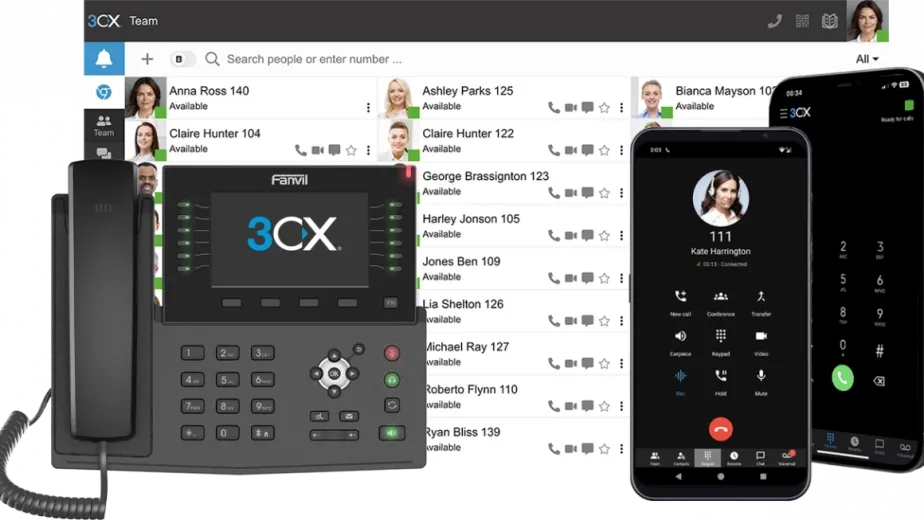
Planning a resilient 3cx enterprise deployment requires far more preparation than running a standard setup wizard on a local server. For multi-site organisations, distributed workforces, and high-volume operations, business telephony is mission-critical infrastructure that demands rigorous capacity planning, zero-downtime failover, and watertight security.
This technical roadmap provides IT leaders with an architectural blueprint for deploying 3CX across complex multi-branch environments, ensuring operational continuity from initial compute sizing to final trunk cutover.
Key takeaways
- Dedicated virtual private servers sized strictly by concurrent calls (SC) and audio recording retention deliver far greater stability than oversubscribed shared hosting.
- Active/passive failover paired with split DNS guarantees seamless client reconnection without manual configuration changes during unexpected outages.
- Deploying dedicated or router-phone Session Border Controllers (SBCs) removes NAT complexity, secures RTP traffic, and conserves branch WAN bandwidth.
- Direct integration with Microsoft Entra ID streamlines user lifecycle management, single sign-on (SSO), and unified communication governance.
- Hardening the perimeter through aggressive geofencing, SIP blacklisting, and mutual TLS protects the business against toll fraud and eavesdropping.
Evaluating Infrastructure: Sizing a Resilient 3CX Cloud Architecture
The foundation of any successful voice rollout begins with compute and hypervisor selection. While small offices often experiment with on-premises mini PCs, enterprise workloads require a robust 3cx cloud architecture hosted in an audited tier-III data centre. Enterprises must determine whether to deploy on dedicated cloud instances or regional infrastructure.
When low latency is paramount for regional operations, leveraging local hosting such as East Africa Virtual Private Servers ensures internal round-trip times remain well below the 50-millisecond threshold required for pristine G.711 and G.729 audio. Oversubscribed public clouds frequently suffer from “noisy neighbour” CPU throttling, which manifests as audio jitter and packet loss during peak calling periods.
Compute sizing must be calculated against simultaneous call licensing rather than total extension count:
| Simultaneous Calls (SC) | Virtual CPU (vCPU) | Dedicated RAM | Baseline SSD Storage |
|---|---|---|---|
| Up to 32 SC | 2 Cores | 4 GB | 50 GB NVMe |
| 32 to 64 SC | 4 Cores | 8 GB | 100 GB NVMe |
| 64 to 128 SC | 8 Cores | 16 GB | 250 GB NVMe |
| 128 to 256+ SC | 16 Cores | 32 GB | 500 GB+ NVMe |
Storage calculations must account for call recording retention policies. A single G.711 call consumes approximately 1 MB of disk space per minute. A contact centre running 50 concurrent channels recording eight hours daily will generate roughly 24 GB of uncompressed WAV files each day. For long-term compliance, configure an automated offload script to move archived audio to secure object storage repositories.

Designing High Availability and Carrier-Grade SIP Trunking
Mission-critical operations cannot tolerate voice outages. Enterprise upgrades echo recent global market shifts; for instance, IT Brief Australia reported that UBS picked BT to modernise global trader communications, demonstrating how world-class institutions treat voice resilience as non-negotiable operational risk mitigation. Implementing 3CX high availability requires a dual-node active/passive pairing deployed across isolated availability zones.
The standby node continuously synchronises configuration databases and system state from the primary node via secure SSH protocols. In the event of primary hardware failure, the secondary node automatically assumes active call management. To prevent registration drops, network teams must implement split-brain DNS resolution. By setting internal and external DNS pointers to an identical Fully Qualified Domain Name (FQDN) with short TTL values, softphones and desktop clients reconnect instantly without user intervention.
Trunking resilience requires multi-carrier redundancy. Dual SIP trunks should be provisioned across physically diverse Internet Service Providers. Configure secondary outbound rules with automated failover prefixes. If the primary trunk experiences upstream packet drop or carrier downtime, outbound calls instantly re-route through the secondary carrier path without alerting the caller.
Branch Office Connectivity: Deploying 3CX SBC Configuration Topology
Connecting distributed branch offices directly across public internet links using standard SIP invites frequent NAT traversal failures, one-way audio, and firewall port exhaustion. A modern 3cx enterprise deployment resolves these challenges by utilising Session Border Controllers at every physical facility.
The 3cx sbc configuration combines all branch SIP signalling and real-time audio channels into an encrypted TLS/SRTP tunnel over a single TCP and UDP port (typically 5090). This structural efficiency delivers clear operational advantages:
- Eliminates NAT issues: On-site firewalls do not require complex port forwarding rules or risky SIP ALG configurations.
- Conserves WAN bandwidth: When two desk phones in the same branch speak to one another, the SBC routes media streams locally rather than hair-pinning traffic through the hosted PBX over the internet.
- Enhances payload security: All voice packets traversing the public WAN are shielded against eavesdropping and packet inspection.
For branch sites with fewer than ten extensions, modern IP phones can serve directly as router phones, executing the SBC function natively on the device hardware. For regional headquarters, hospitals, or manufacturing hubs with dozens of handsets, install a dedicated SBC instance on a local Linux virtual appliance to ensure rock-solid packet processing.
Directory Synchronisation and Enterprise Workflow Integration
Disparate communication systems isolate operational data and increase administrative burden. Consolidating tools is an enterprise priority. As Telecom Reseller / Technology Reseller News covered, providers such as CallTower build one-stop cloud communications for global teams to streamline multi-platform environments. A mature hosted 3cx phone system must integrate natively into core enterprise directories and daily collaboration tools.
Integrating Microsoft 365 and Microsoft Entra ID establishes an authoritative identity source. By establishing an application registration within your tenant, user creation and deprovisioning occur automatically. When onboarding an employee, their 3CX extension, web client permissions, and mobile routing profiles populate based on their directory group membership.
Furthermore, unifying communications with enterprise CRM and ERP platforms elevates workforce productivity. Server-side API connectors allow instant screen-pops on inbound calls, matching caller numbers against customer records. This capability ensures account managers, clinic nurses, or hotel desks possess full context before answering, while call logs, recordings, and duration metrics synchronize automatically to contact timelines.
Hardening the Perimeter: Zero-Trust Voice Security
Telephony systems remain prime targets for automated brute-force attacks and toll fraud networks. Securing a 3cx enterprise deployment requires a zero-trust network posture combining application-level filters with hardened perimeter inspection.
First, restrict administrative console access. Bind the administration portal to designated management VLANs or require a corporate VPN connection. Enforce multi-factor authentication (MFA) across all administrative accounts without exception. Under the PBX security settings, activate automated global IP blacklisting, which queries live threat intelligence feeds to block hostile IP addresses attempting credential stuffing.
Second, implement strict outbound call geofencing. High-risk international destinations should be globally barred at the system level. Configure outbound dial plans so that international destinations require explicit managerial extension privileges or dedicated PIN prompts. Coupled with multi-layered perimeter inspection from enterprise firewalls such as Fortinet cybersecurity appliances, voice platforms remain isolated from external intrusion and botnet scans.
Executing the Enterprise VoIP Rollout: Migration and Cutover Checklist
Transitioning hundreds of users from an aging PBX to a modern platform demands structured execution. Avoid flash cutovers; phased rollouts minimise operational disruptions and allow networking teams to validate real-time bandwidth performance under progressive load.
- Phase 1: Network Readiness Assessment: Verify local switches support 802.3af/at Power-over-Ethernet (PoE), implement strict VLAN tagging for voice traffic (802.1Q), and establish Layer 3 QoS (DSCP 46 / Expedited Forwarding).
- Phase 2: Directory and Trunk Staging: Sync user directories, configure call queues, ivr trees, and emergency service dispatch routes. Stand up carrier trunks and test outbound routing.
- Phase 3: Hardware Provisioning: Mass-provision desk phones via RPS (Redirect and Provisioning Service). Ensure physical handsets such as Yealink or Fanvil run verified firmware versions.
- Phase 4: Pilot Department Deployment: Migrate a tech-savvy operational unit first. Validate call audio clarity, SBC failover, mobile client responsiveness, and desktop screen-pop performance.
- Phase 5: Coordinated Number Porting: Execute the carrier port during off-peak operational windows. Retain forwarding numbers on legacy circuits until inbound trunks pass end-to-end testing.
A disciplined enterprise voip rollout guarantees zero dropped customer calls and preserves workforce continuity throughout the entire migration cycle.
Maintaining Operational Excellence in Enterprise Voice
Deploying business communications across modern branch networks requires technical precision, resilient architecture, and persistent operational monitoring. By sizing dedicated compute properly, leveraging SBC edge security, and implementing redundant carrier paths, organisations can insulate themselves against costly voice outages and security liabilities.
Organisations looking to implement a resilient 3cx enterprise deployment often benefit from collaborating with certified engineering specialists who manage voice networks end-to-end. At Call Experts, our infrastructure specialists design, deploy, and monitor carrier-grade voice systems tailored to demanding multi-branch environments. When your organisation is ready to modernize its legacy communications or architect a robust multi-site PBX environment, contact our engineering team to discuss your deployment requirements.
Frequently asked questions
What is the primary function of a 3CX Session Border Controller (SBC)?
A 3CX SBC connects branch offices to a remote PBX by bundling all signalling and media through a single encrypted port. This eliminates the need for complex firewall rules, solves NAT audio issues, and enables local phone-to-phone media routing.
How does 3CX achieve high availability during a server failure?
High availability is achieved through an active/passive topology where a secondary standby server synchronises configurations from the primary node. If the primary node fails, the secondary assumes the active role, and split DNS directs clients seamlessly to the backup.
Can existing analogue desk phones or door interims be used with 3CX?
Yes. Analogue phones, legacy fax machines, and paging systems connect to 3CX using supported Analogue Telephone Adapters (ATAs) or FXS VoIP gateways, preserving existing equipment investments while migrating the core platform to the cloud.
How is 3CX licensing calculated for enterprise organisations?
3CX licenses are calculated purely on Simultaneous Calls (SC) rather than per-user monthly subscriptions. Any number of internal extensions can be created, provided the total volume of concurrent inbound, outbound, and internal calls remains within the licensed threshold.
Sources
- UBS picks BT to modernise global trader communications — IT Brief Australia, 2026-10-12
- How CallTower Builds One-Stop Cloud Communications For Global Teams — Telecom Reseller / Technology Reseller News, 2026-10-12