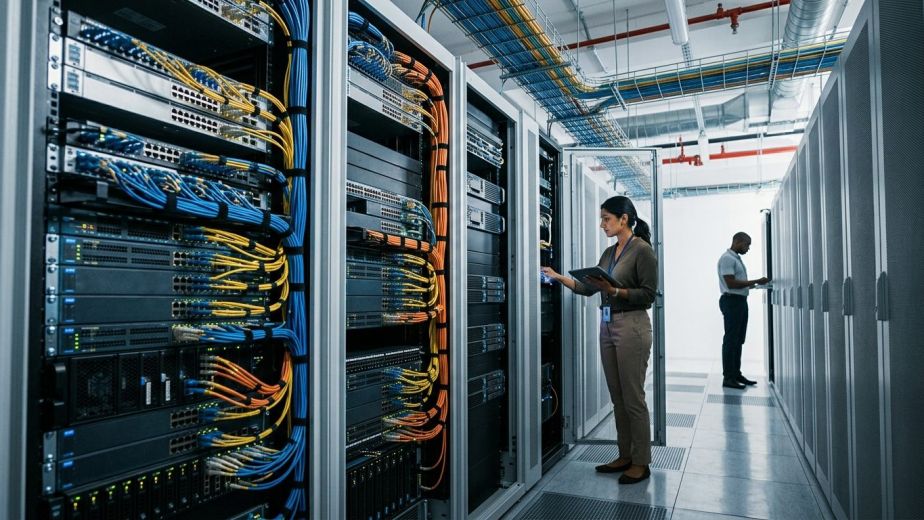
Conducting a comprehensive yeastar p-series comparison is essential for technology leaders evaluating modern unified communications architectures. Whether modernising legacy telephone networks or consolidating distributed branch offices, choosing between on-premises hardware, virtualised software, and cloud infrastructure determines long-term voice resilience and operational expenditure. This practical comparison outlines the functional differences, latency factors, remote connectivity models, and infrastructure requirements across every edition.
Key takeaways
- Hardware appliances (P550, P560, P570) offer local telephony interface modularity (FXO, FXS, E1 PRI) and active-standby high availability without ongoing hypervisor compute overhead.
- Software Edition delivers elastic resource scaling on private hypervisors or private cloud infrastructure, supporting up to 10,000 users under full administrative control.
- Cloud Edition removes server maintenance entirely while standardising remote access, though it relies exclusively on VoIP carrier trunks.
- All three deployment tracks share the core feature stack, including call centre routing, switchboard monitoring, and secure remote worker provisioning via Linkus UC.
The Modern Voice Landscape and Yeastar PBX Models
Enterprise communications are undergoing a global shift away from isolated, proprietary hardware systems. As reported by IT Brief Australia, Tier-1 financial institutions like UBS recently selected BT to modernise global trader voice systems, reflecting an industry-wide drive towards consolidated, agile communication platforms. Similarly, Telecom Reseller / Technology Reseller News highlighted how providers like CallTower build one-stop cloud communications for global teams to eliminate voice fragmentation. When selecting a modern yeaster system, organisations must assess whether a physical appliance, a private host, or a turnkey cloud instance aligns best with their operational goals.
The modern portfolio of yeastar pbx models is designed to unify team telephony, video, messaging, and customer contact channels. Rather than requiring distinct software layers for separate media types, Yeastar provides an identical operational experience to the end-user across devices. However, the underlying platform architecture dictates how an organisation manages call routing, voice survivability, and peripheral hardware integrations.
Organisations reviewing a yeastar p-series comparison typically manage hybrid workplaces where employees split time between physical offices, regional branches, and home environments. Delivering stable voice services across these varied environments requires careful consideration of the physical deployment medium.

Yeastar Appliance vs Cloud: Deployment Architecture Breakdown
Evaluating yeastar appliance vs cloud deployments requires looking closely at network topologies, legacy interface dependencies, and server infrastructure. The P-Series addresses enterprise voice through three distinct deployment formats:
1. P-Series Hardware Appliances (P550, P560, P570)
Hardware appliances represent a self-contained, turnkey telephony server engineered directly for rack installation. These appliances eliminate hypervisor management and operating system patching. Crucially, they include modular expansion slots that accept physical telephony boards, such as FXS ports for analogue room phones, FXO ports for PSTN fallback, and E1/PRI interfaces for legacy digital trunks.
2. P-Series Software Edition
The Software Edition packages the entire platform as an operating system ISO image or virtual appliance. IT teams deploy it on hypervisors such as VMware vSphere, Microsoft Hyper-V, or KVM, as well as private cloud compute instances. This architecture gives engineering teams granular governance over data sovereignty, snapshot cycles, storage allocation, and regional network boundaries.
3. P-Series Cloud Edition
The Cloud Edition delivers a turnkey cloud PBX environment hosted in enterprise data centres. It eliminates on-premises voice hardware and hypervisor maintenance entirely. System administrators manage call logic, extensions, and routing rules through a web browser, leaving underlying infrastructure scaling, security updates, and operating system maintenance to the cloud service provider.
| Operational Feature | Hardware Appliance | Software Edition | Cloud Edition |
|---|---|---|---|
| Target User Sizing | Up to 500 extensions (P570) | Up to 10,000 extensions | Up to 2,000 extensions per tenant |
| Max Concurrent Calls | Up to 120 calls (P570 expandable) | Up to 1,000 concurrent calls | Scalable based on user profile |
| Physical Line Support | Native modular boards (FXO/FXS/E1) | Requires external VoIP gateways | VoIP SIP trunks only |
| Infrastructure Responsibility | Local appliance hardware | Internal hypervisor or private host | Fully managed cloud provider |
| High Availability Model | Active-standby physical pairing | Hypervisor HA, live migration, VM replication | Automated cloud platform failover |
When planning your yeastar p-series sizing, remember that user counts and maximum concurrent calls dictate the necessary processing headroom. Under-provisioning compute resources on virtual platforms can lead to packet jitter and buffer underruns during peak calling hours.
Remote Worker Architecture and Yeastar Linkus UC Security
Modern organisations require seamless mobile and desktop communications that do not depend on fixed office desks. The yeastar linkus uc application serves as the primary softphone and collaboration client for users across Windows, macOS, iOS, Android, and web browsers. It provides real-time presence, unified messaging, voice calling, video conferencing, and direct CRM access.
Connecting distributed users to an on-premises or private voice server has historically presented security challenges. Conventional configurations often required either complex site-to-site VPNs—which introduce latency and client overhead—or public port forwarding, which exposes SIP signalling ports to scanning and brute-force registration attempts. Yeastar solves this problem using its proprietary Remote Access Service (RAS).
RAS uses an encrypted, outbound HTTPS reverse proxy tunnel to connect the PBX with global endpoints. External Linkus clients register securely using a fully qualified domain name (FQDN) without opening port 5060 or RTP media ranges on the perimeter firewall. For organisations operating a hybrid workforce, RAS provides enterprise-level boundary defense while keeping softphone onboarding simple. Reviewing this remote security mechanism is a critical element of any yeastar p-series comparison.
To further understand enterprise deployments, consult our Yeastar IP PBX deployment guide for best practices on network segmentation and voice quality optimisation.
Call Centre and Omnichannel Features Across Editions
A major benefit of the P-Series ecosystem is feature parity across all three deployment models. Businesses running customer service teams or internal helpdesks gain access to a capable contact centre suite regardless of whether they choose hardware, virtualised, or cloud hosting.
Key operational capabilities include:
- Visual Switchboard: Dispatchers and team leads monitor real-time queue volumes, extension presence, active call durations, and agent availability using an interactive web interface.
- Advanced Queue Routing: Inbound calls route according to round-robin, least-talk-time, skills-based, or priority agent strategies, balancing agent workload evenly.
- Queue Callback: Callers waiting in peak-hour queues can request an automated callback without losing their queue position, which lowers customer frustration and trunk holding times.
- Supervisory Modes: Team leaders can listen in silently, whisper coaching prompts to agents in real time, or barge into active conversations when escalations occur.
- Omnichannel Integrations: Inbound SMS and popular messaging channels route into the same Linkus desktop workspace, giving agents a single queue for text and voice conversations.
The platform also integrates directly with enterprise systems such as Salesforce, Zoho, HubSpot, and Microsoft 365. When a call arrives, an automatic screen-pop presents the caller’s CRM profile before the agent answers. This capability is standard across the platform, making the choice between appliance, software, and cloud depend purely on network architecture and infrastructure strategy.
Resilience, Redundancy, and Multi-Site Networking
Voice is a real-time, mission-critical service. In healthcare, hospitality, and emergency operations, system downtime disrupts core business functions. As a result, assessing disaster recovery models is a foundational step in any technical yeastar p-series comparison.
For on-premises hardware deployments, the P560 and P570 support active-standby high availability. Two identical appliances connect directly through an Ethernet heartbeat link. Configuration settings, call recordings, voicemails, and active registration states replicate in real time. If the primary appliance suffers a hardware or power failure, the standby unit assumes the virtual IP address and takes over call processing within seconds, avoiding dropped trunk registrations.
For virtualised Software Edition environments, resilience depends on your underlying hypervisor configuration. IT teams can leverage VMware vSphere High Availability, automated snapshots, and storage-level replication. When deployed in private cloud facilities or regional environments like East Africa Virtual Private Servers, organisations achieve low network latency while benefiting from automated hardware failover and enterprise power redundancy.
Multi-site organisations can also build a unified corporate voice network across distributed branches. Using Yeastar’s branch office interconnect technology, disparate appliances and cloud instances link together over secure private tunnels. Internal four-digit extension dialling, free inter-office calls, and centralised call routing work across physical locations without complex, third-party session border controllers.
Yeastar P-Series Comparison: Cost of Ownership and Decision Framework
Deciding between an appliance, a private software installation, or a cloud PBX requires balancing capital expenditure (CapEx) against operational expenditure (OpEx). Each deployment strategy carries distinct total cost of ownership (TCO) considerations.
Hardware appliances require an initial capital outlay for the appliance chassis, interface modules, and optional maintenance warranties. However, they carry minimal recurring software costs if deployed for basic local switching. Adding advanced features like RAS, video conferencing, CRM integrations, and omnichannel messaging requires Yeastar Enterprise or Ultimate subscription plans.
The Software Edition shifts capital costs to existing hypervisor infrastructure. You purchase license capacity to match your user count and concurrent call requirements, which provides an efficient path for scaling up without replacing physical appliances. This makes the software edition particularly attractive for organisations that already run resilient virtual environments.
The Cloud Edition operates entirely on an annual per-user or shared subscription basis. It eliminates upfront server investments and local maintenance overhead. However, it requires a dependable, low-jitter Internet connection and dedicated enterprise SIP trunking, as you cannot plug local analogue or ISDN lines into a cloud platform.
When performing your final yeastar p-series comparison, use the following operational checklist to guide your decision:
- Do you require physical PSTN or legacy analogue line connectivity? If yes, choose a Hardware Appliance or deploy external VoIP gateways alongside Software Edition.
- Does your organisation maintain internal virtualisation infrastructure? If you have dedicated server clusters with existing backup processes, Software Edition provides the greatest operational control.
- Are your users entirely distributed with no central office server room? If so, Cloud Edition removes all local footprint and delivers immediate access through web and mobile clients.
- Are there strict data residency regulations governing your call records? If call recordings and customer data must stay within regional borders, select an on-premises appliance or a regionally hosted Software Edition instance.
Organisations requiring comprehensive voice design, carrier trunk provisioning, and local support can explore our wider telephony solutions to streamline implementation.
Selecting the Right PBX Architecture for Your Business
Choosing the correct telephony architecture requires finding the right balance between control, operational simplicity, and long-term infrastructure investment. The Yeastar P-Series ecosystem offers consistent feature access and user experience across all three deployment models. Hardware appliances deliver self-contained, physical survivability; the Software Edition enables elastic scaling within private datacentres; and the Cloud Edition provides rapid, zero-maintenance deployment for modern hybrid teams.
Working with an experienced technology partner helps ensure your voice architecture matches your network design and operational workflows. At Call Experts, we design, deploy, and manage enterprise voice systems built for uptime, security, and scalability. To discuss your requirements, explore deployment architectures, or arrange a tailored system sizing, please visit our contact page to speak with one of our telephony specialists.
Frequently asked questions
Can I migrate from a Yeastar Hardware Appliance to the Cloud Edition later?
Yes. Yeastar supports cross-platform configuration backups. You can export user extensions, IVR call flows, ring groups, and dial plans from a P-Series hardware appliance and restore them directly into a Software Edition or Cloud Edition instance, significantly simplifying future platform migrations.
Does Yeastar Software Edition require dedicated server hardware?
No. Software Edition runs efficiently within virtualised environments on VMware, Hyper-V, or KVM hypervisors. You can allocate virtual CPU cores, RAM, and disk space according to your expected extension counts and concurrent calling volume without purchasing a standalone physical server.
How does Yeastar Remote Access Service secure Linkus UC connections?
Remote Access Service uses a secure, outbound HTTPS tunnel between the PBX and Yeastar cloud proxy nodes. Mobile and desktop Linkus clients connect over this encrypted channel, eliminating the need to expose open SIP ports or configure complex VPN tunnels on your perimeter firewall.
Can I connect analogue extensions or door phones to Yeastar Cloud Edition?
Yes, but you cannot connect them directly to the cloud. You must install a local VoIP gateway (such as a Yeastar TA-series FXS gateway) on-site. The gateway converts analogue signals to SIP and registers securely across your Internet connection to the cloud PBX.
Sources
- UBS picks BT to modernise global trader communications — IT Brief Australia, 2026-10-12
- How CallTower Builds One-Stop Cloud Communications For Global Teams — Telecom Reseller / Technology Reseller News, 2026-10-12