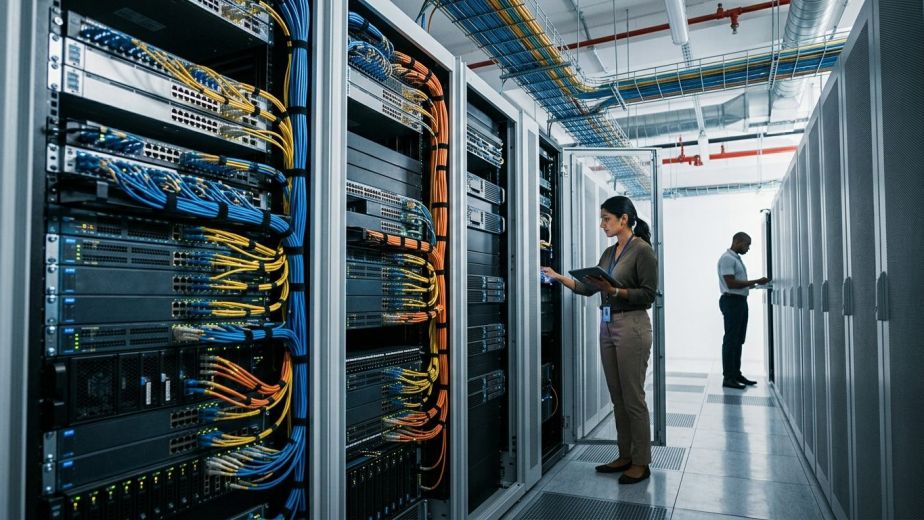
This comprehensive data center colocation guide delivers an engineering-first evaluation framework for enterprise IT leaders seeking dependable infrastructure resilience. As on-premise server rooms struggle with rising energy costs and public cloud bills mount from data egress, moving critical workloads to a third-party facility offers substantial operational advantages. This guide examines how to assess facility architecture, evaluate power distribution, and negotiate enterprise-grade service agreements.
Key takeaways
- Assess rack power density and cooling containment early to avoid thermal throttling and stranded power capacity.
- Prioritise carrier-neutral facilities with diverse fibre entries to prevent telecommunications lock-in and reduce transit costs.
- Scrutinise Master Service Agreements (MSAs) for meaningful financial remedies rather than nominal service credits during outages.
- Verify multi-tenant physical security boundaries, compliance certifications, and Remote Hands capabilities before signing.
Moving Beyond On-Premise Server Rooms: The Business Case for Colocation
For decades, organisations maintained internal computer rooms across corporate headquarters. However, dense virtualisation, modern storage clusters, and high-performance computing have made these legacy rooms liability points. Internal facilities rarely possess the structural floor loading, redundant backup generators, or dual-loop chilled water systems necessary for uninterrupted operations. Transitioning to professional data center services solves these physical constraints immediately.
Furthermore, cloud repatriation is accelerating. While hyperscale public cloud platforms provide rapid scalability, sustained data-intensive workloads often generate unpredictable monthly egress and compute charges. Placing core enterprise databases and steady-state applications in a colocation facility brings predictable operational expenses while retaining direct hardware ownership. Combining private infrastructure with direct cloud interconnects delivers the financial predictability of on-premise compute alongside the agility of modern cloud services.
When establishing your initial colocation facility requirements, focus on long-term business continuity rather than simple floor-space pricing. Evaluating rack space without examining underlying infrastructure resilience creates significant operational risk down the line.
Data Center Colocation Guide: Power, Cooling, and Redundancy Architecture
Electrical delivery represents the single most critical factor in any hosting environment. An authoritative data center colocation guide helps infrastructure teams dissect how power travels from utility substations to your server racks. True enterprise facilities provide 2N (fully duplicated) or N+1 (component-redundant) power distribution paths. Ensure the facility delivers dual-corded A and B power feeds sourced from entirely independent transformers and uninterrupted power supply (UPS) banks.
Rack power density has climbed steadily. While standard legacy racks consumed between 2 kW and 5 kW, modern high-density compute, hyperconverged nodes, and storage arrays regularly require 10 kW to 20 kW or more per cabinet. Verify that the provider can deliver the required kilovolt-ampere (kVA) allocations without forcing you to purchase empty adjacent racks to dissipate heat.
Thermal management is equally paramount. The American Society of Heating, Refrigerating and Air-Conditioning Engineers (ASHRAE) establishes international guidelines for data centre thermal bands. Modern facilities must deploy hot-aisle or cold-aisle containment systems. Enclosing the aisle prevents the mixing of cold supply air and hot exhaust air, dramatically improving cooling efficiency and eliminating thermal hot spots that degrade enterprise hardware.
Carrier Neutral Colocation and Hybrid Cloud Interconnects
Connectivity is the lifeblood of colocation. A facility tethered to a single telecommunications operator exposes your enterprise to single points of failure and monopolistic transit pricing. Insisting on carrier neutral colocation ensures you can cross-connect directly to multiple regional and global transit providers, dark-fibre carriers, and software-defined network exchanges within the building meet-me room (MMR).
Carrier neutrality forms the backbone of a successful hybrid cloud colocation architecture. Rather than routing all traffic over the public internet, organisations can establish dedicated private cross-connects to cloud on-ramps such as Microsoft Azure ExpressRoute or AWS Direct Connect. By pairing low-latency cloud connections with on-premise hardware, enterprises can execute an orchestrated Azure cloud migration strategy, hosting sensitive databases locally while bursting application front-ends into public hyperscalers.
To safeguard wide-area networking resilience, ensure the facility features diverse physical fibre entry points. True redundancy requires dual carrier manholes on opposite sides of the building. This physical separation prevents a single errant backhoe or road excavation from cutting all external communications links simultaneously. Integrating this resilient architecture alongside modern managed SD-WAN solutions guarantees intelligent traffic failover across diverse paths.
Physical Security, Zoning, and Multi-Tenant Compliance
Sharing a building with multiple tenants introduces physical security boundaries that must be independently audited. According to reporting by ET CIO SEA, Malaysia held high-level security meetings on cyber threats and specifically flagged data centre strength as a risk, highlighting how physical infrastructure resilience has become an urgent national security priority. Multi-tenant operators must maintain strict segregation between common areas, staging rooms, and customer white space.
Verify that your equipment will be housed in dedicated lockable cabinets or secure wire-mesh cages equipped with combination, keycard, or biometric readers. The facility perimeter must deploy anti-ram barriers, multi-factor biometric mantraps, continuous digital CCTV coverage with 90-day archive retention, and strict visitor access controls. Unescorted access should be restricted exclusively to pre-authorised personnel on an approved access list.
Compliance frameworks provide third-party validation of these physical safeguards. Depending on your industry vertical, demand current audit certificates covering:
- SOC 2 Type II: Validating operational controls, security principles, and data confidentiality over an extended observation period.
- ISO 27001: Verifying international best practices for information security management systems.
- PCI DSS: Ensuring physical containment standards for systems storing or processing cardholder data.
For organisations processing healthcare or financial transactions, combining these physical protections with perimeter firewalls and strict network segmentation, such as an enterprise-grade Fortinet firewall deployment, ensures comprehensive regulatory alignment.
Decoding Colocation SLA Tiers and Contractual Liabilities
Service Level Agreements (SLAs) must be evaluated with legal and technical precision. As noted in a report by Marsh, contract risk management has become a critical board-level priority for data centres. Any reliable data center colocation guide must scrutinise the legal remedies provided when facility systems fail, ensuring risk is appropriately distributed between tenant and landlord.
Facility marketing often highlights uptime classifications defined by organisations like the Uptime Institute. However, contractual uptime commitments differ significantly across colocation sla tiers:
| Contractual Availability | Permitted Downtime Per Year | Facility Architecture Typical | Operational Risk Profile |
|---|---|---|---|
| 99.9% (Three Nines) | 8 hours, 45 minutes | Single-path, N power/cooling | High risk for production enterprise applications |
| 99.99% (Four Nines) | 52 minutes, 35 seconds | Concurrently maintainable (N+1) | Acceptable for standard business workloads |
| 99.999% (Five Nines) | 5 minutes, 15 seconds | Fault tolerant, 2N distribution | Enterprise grade for mission-critical services |
| 100% Commitment | 0 minutes | 2N+ redundant utility and power | Tier IV standard with robust active-active design |
Examine the fine print of the Master Service Agreement. Many providers offer service credits limited to a small percentage of your monthly space rental, which falls far short of covering real business losses from an extended outage. Verify the Mean Time to Restore (MTTR) metrics, environmental SLA bands (guaranteed temperature and relative humidity parameters), and ensure chronic failure clauses permit unilateral contract termination without penalty.
Data Center Colocation Checklist: Operational Hand-Off and Day-2 Governance
The successful execution of your hosting strategy depends on operational hygiene. Use this structured data center colocation checklist to guide hardware staging, deployment, and ongoing vendor governance:
- Rack Layout and Weight Distribution: Position heavy UPS units, power distribution units (PDUs), and storage chassis at the bottom of the rack to maintain a low centre of gravity.
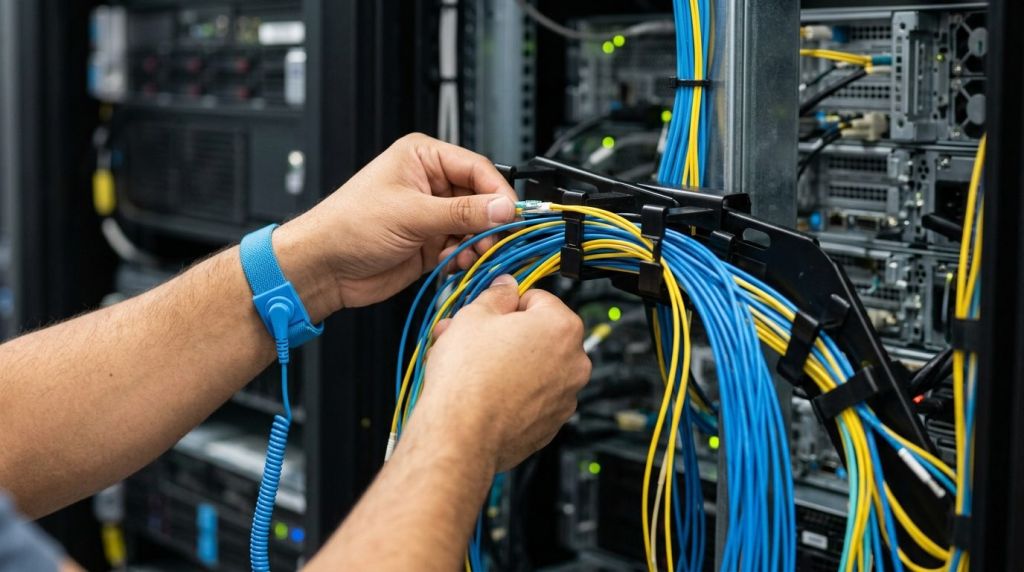
- Structured Cabling: Enforce strict colour-coding standards for Cat6A and optical fibre patch cables. Separate power cables from data lines to prevent electromagnetic interference.
- Out-of-Band (OOB) Management: Deploy independent console servers connected to dedicated cellular or secondary out-of-band networks. This ensures network engineers can access critical equipment even during primary WAN outages.
- Remote Hands Verification: Test provider Remote Hands services prior to production cutover. Validate their engineering skill sets, mean response times, and emergency response capabilities.
- Environmental Telemetry: Install smart PDUs with temperature and humidity sensors at the top, middle, and bottom of the rack to independently monitor microclimates.
Building an Enduring Infrastructure Partnership
Selecting a colocation provider is a long-term strategic commitment that shapes your technology architecture for years to come. By rigorously evaluating power distribution, thermal efficiency, carrier neutrality, and contractual liabilities, you protect your organisation from unexpected downtime and costly renegotiations. Call Experts works with growing enterprises and mid-market organisations internationally to design, deploy, and support resilient hosting architectures, cloud interconnects, and infrastructure management.
For engineering guidance, architecture reviews, or detailed commercial quotations, speak to our infrastructure specialists via our contact page.
Frequently asked questions
What is the difference between colocation and public cloud hosting?
Colocation provides dedicated physical space, power, cooling, and security for your own hardware inside an enterprise data facility. In contrast, public cloud services rent shared virtual compute, storage, and networking resources managed entirely by a hyperscale cloud provider on a subscription basis.
What is the difference between N+1 and 2N redundancy in data centres?
N+1 redundancy includes one extra component (like a generator or cooling unit) beyond the baseline capacity needed for operations. A 2N architecture provides a completely duplicated mirror of the entire infrastructure, ensuring total system continuity even if an entire primary power or cooling line fails.
Why is carrier neutrality important when choosing a colocation facility?
Carrier neutrality allows you to connect directly to multiple internet service providers, regional network operators, and cloud on-ramps within the same building. This prevents supplier lock-in, encourages competitive transit pricing, and delivers resilient connectivity with independent failover paths.
What services do data centre Remote Hands include?
Remote Hands services provide on-site technical assistance from facility engineers. Tasks typically include power cycling frozen servers, swapping hot-swappable hard drives, verifying physical cable connections, checking hardware diagnostic indicator lights, and receiving or racking newly delivered customer equipment.
Sources
- Malaysia holds security meetings on cyber threats, flags data centre strength as a risk — ET CIO SEA, 2026-11-03
- Contract risk management is a critical board-level priority for data centres. Here's how to get ahead of it — Marsh, 2026-11-02