
Selecting a modern hotel PBX is no longer just about placing a telephone on a bedside table. A contemporary voice platform functions as an operational nerve centre, connecting guest requests directly with housekeeping, engineering, and property management workflows. This guide delivers a technical and operational blueprint for general managers and hotel IT leaders seeking reliable telephony that protects capital expenditure while elevating guest satisfaction.
Key takeaways
- Preserve guestroom copper cabling using high-density FXS analog gateways to avoid disruptive re-cabling costs.
- Ensure bi-directional PMS integration via certified FIAS or REST APIs to automate billing, guest privacy, and room status updates.
- Deploy multi-cell DECT systems to keep roving maintenance and housekeeping teams connected across large properties.
- Design survivable hybrid telephony architectures to protect emergency dispatch during Internet service provider outages.
The Evolution of the Hotel PBX: Beyond the Switchboard
Legacy hospitality telephone systems were historically treated as cost centres designed primarily for room-to-front-desk communication. However, the rise of guest mobile devices and the discontinuation of legacy platforms have fundamentally shifted expectations. Today, modern hotel PBX systems must act as unified communications hubs that coordinate front-of-house service, back-of-house logistics, and life-safety compliance.
Hotels upgrading their infrastructure require robust software platforms that bridge digital workflows with legacy hardware. Rather than relying on outdated proprietary boxes, properties are deploying versatile platforms like 3CX Business Communications and Yeastar Business Communications. These solutions convert basic voice channels into dynamic tools for service dispatch, automated guest wake-ups, and rapid staff escalations.
Essential Hotel PBX Features: Guest Experience vs. Operations
When drafting technical requirements for a new pbx for hotels, procurement teams must balance guest-facing conveniences against operational efficiency tools. If an enterprise telephony platform lacks purpose-built hospitality workflows, staff spend unnecessary hours on manual updates.
Guest-Facing Capabilities
Guest room endpoints must offer intuitive, friction-free operation. Key hotel PBX features include one-touch programmable speed dials for reception, room service, concierge, and spa facilities. Automated wake-up calls with customisable language prompts ensure reliability without tying up front desk staff during early-morning peaks. Additionally, dynamic Do-Not-Disturb (DND) modes synchronise with guest room management systems, while voicemail-to-email routing ensures business travellers never miss critical external messages.
Back-of-House Operational Tools
For housekeeping and facility management, telephony endpoints provide real-time updates directly from guestrooms. Room attendants can pick up any guestroom handset, dial a short status code (such as clean, inspected, or maintenance required), and instantly update the front desk. Built-in interactive voice response (IVR) systems handle high-volume operational inquiries, routing supplier deliveries, reservations, and conference queries to the correct departments without front desk intervention.
PMS Integration: The Backbone of Hospitality Telephony
A hospitality telephony rollout succeeds or fails based on its Property Management System (PMS) interface. Without seamless hotel pbx pms integration, hotel teams face fractured workflows, unbilled external telephone calls, and privacy blind spots.
Enterprise platforms interface with market-leading systems such as Oracle Hospitality Opera, Fidelio, and cloud-native PMS platforms using standard protocols like FIAS (Fidelio Inter-Adapter Software) or secure web APIs. Industry standards documentation from Oracle Hospitality demonstrates how tightly coupled interfaces protect guest data and maintain audit trails.
This bidirectional interface performs several automated functions upon guest check-in and check-out:
- Extension Provisioning: The guest’s surname instantly displays on console screens when they ring reception, enabling personalised service.
- Toll Restriction: Outgoing external call permissions activate automatically upon check-in and immediately bar unauthorized international or premium dialing upon check-out.
- Call Accounting: Metered call charges post automatically to the guest folio in real time, preventing disputed checkout balances.
- Voicemail Clearing: Stored guest voice messages and personalized mailboxes purge immediately upon departure to safeguard guest privacy.
Deployment Architectures: Cloud, On-Premises, and Hybrid Gateways
Choosing the ideal deployment topology requires evaluating property layout, existing infrastructure, and network resilience. Hoteliers typically weigh a fully hosted cloud hotel pbx against an on-premises or hybrid voice architecture.
| Architecture Model | Primary Advantages | Key Considerations | Best Suited For |
|---|---|---|---|
| Fully Cloud Hosted | Minimal server hardware; automatic software updates; simple multi-property administration. | Requires fully redundant Internet links; per-room bandwidth overhead. | Boutique hotels, new construction, and city-centre business hotels with fiber redundancy. |
| Hybrid with FXS Gateways | Preserves existing copper wiring; provides local survivability; lower initial capital outlay. | Requires rack space for gateways and managed enterprise switching. | Established properties with 100+ guestrooms seeking zero-downtime upgrades. |
| Dedicated On-Premises | Total data sovereignty; complete local call routing independent of public cloud status. | Higher upfront hardware spend; routine maintenance and local power backup required. | Large resorts, safari lodges, or remote properties with volatile WAN connectivity. |
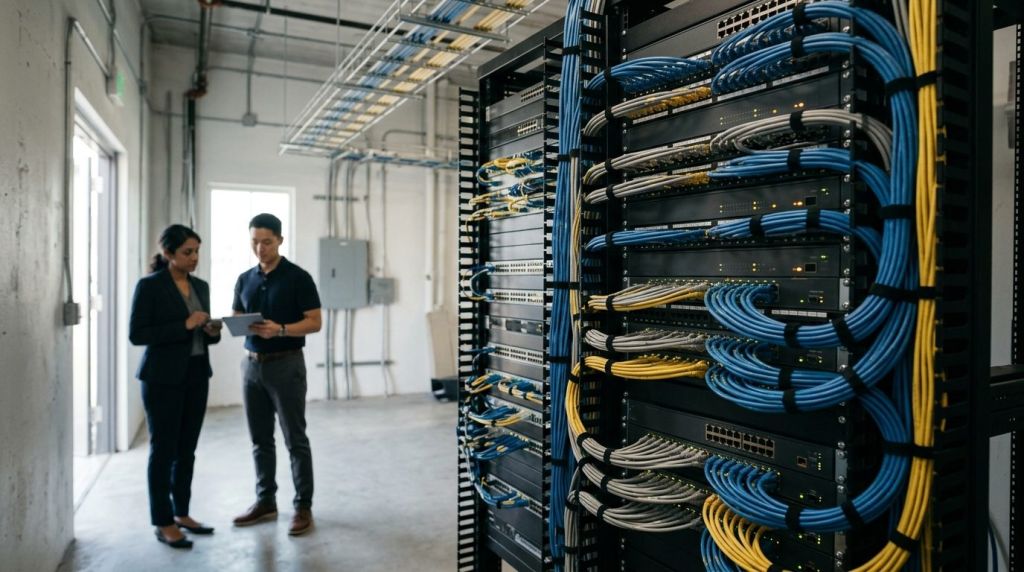
For established properties, re-cabling hundreds of rooms with modern Ethernet cabling represents a disruptive, cost-prohibitive project. Deploying high-density FXS VoIP gateways bridges this divide effectively. These appliances connect to existing two-wire analog twisted-pair copper infrastructure in floor distribution frames, converting analog room signals into standard SIP traffic for the central hotel PBX core.
Hardware Selection: Guestroom Consoles, DECT Endpoints, and Safety Standards
A complete hospitality phone system encompasses a range of specialised endpoints tailored to diverse operational environments across the property.
Guestroom Consoles
Guestroom devices must be durable, compact, and easy to sanitise. Modern hospitality phones from manufacturers like Fanvil and Yealink feature anti-microbial plastics, customisable faceplates with hotel branding, and integrated USB ports for guest mobile charging. In luxury suites, touchscreen IP consoles can also interface with room automation systems to control lighting and climate.
Back-of-House Mobility with Multi-Cell DECT
Housekeeping supervisors, security staff, and engineering technicians rarely remain seated near a fixed desk. Multi-cell DECT (Digital Enhanced Cordless Telecommunications) networks deliver seamless roaming across expansive corridors, basements, and outdoor grounds. Unlike consumer Wi-Fi calling, enterprise DECT operates on dedicated frequency bands, eliminating handover drops and dead zones.
Emergency Dialing Standards and Direct Dispatch
Modern telecommunications compliance requires robust emergency routing. When a guest or employee dials an emergency number, the hotel PBX must connect the call immediately without requiring an outside trunk prefix (such as dialing 9 first). The system must simultaneously broadcast an automated emergency alert across security consoles and management extensions, pinpointing the exact room number and floor coordinates for emergency responders.
Total Cost of Ownership: Licensing, SIP Trunks, and Maintenance
Evaluating the total cost of ownership requires looking beyond the initial hardware purchase order. Traditional PBX vendors frequently charged licensing fees for every connected room extension, making systems with hundreds of rarely used bedside phones exorbitantly expensive.
Modern software platforms disrupt this model. Systems like 3CX license based on simultaneous call capacity rather than per-extension metrics. Because guestroom phones generate minimal concurrent traffic compared to administrative offices, simultaneous-call licensing dramatically slashes recurring operational overhead.
Furthermore, migrating from legacy ISDN PRI circuits to centralized SIP trunking yields immediate monthly communications savings. SIP trunks consolidate voice traffic over enterprise data links, allowing hotels to burst channel capacity during busy conference seasons and scale back during low occupancy periods.
Hotel PBX Migration Checklist: Zero-Downtime Rollout Strategy
Transitioning an operational hotel to a new communication platform requires military precision. To prevent disruptions to guest stays, experienced technology teams like Call Experts follow a structured cutover methodology.
- Infrastructure and Network Audit: Inspect cabling risers, test existing analog pairs, and configure dedicated voice VLANs with 802.1p Quality of Service (QoS) across core switches.
- Middleware and PMS Validation: Establish and stress-test the bi-directional PMS connection in a staging environment to confirm extension mapping, call accounting, and billing accuracy.
- Pilot Zone Deployment: Convert an administrative floor or a small block of vacant guestrooms first. Validate automated wake-up triggers, emergency routing, and external audio clarity.
- Parallel Cutover Execution: Run the modern hotel PBX concurrently with the outgoing system. Port external pilot numbers during scheduled low-traffic hours, migrating floor gateways sequentially.
- Staff Training and Verification: Deliver role-based training for front desk agents, night auditors, and facility teams before formal sign-off.
Modernising Your Hospitality Telephony
An outdated telephone system risks guest dissatisfaction, hampers housekeeping velocity, and creates compliance vulnerabilities during emergencies. By selecting a modern hotel PBX that pairs high-density analog gateways with flexible licensing and certified PMS connectivity, properties achieve modern operational efficiency without the expense of rewiring guestrooms.
Whether you manage a boutique lodge or a high-capacity resort, reliable voice infrastructure underpins every guest interaction. To evaluate your existing cabling, explore hybrid architectures, or request a technical assessment, contact Call Experts today to discuss your telephony requirements.
Frequently asked questions
Can we upgrade our hotel PBX without replacing existing guestroom copper wiring?
Yes. By installing high-density analog FXS VoIP gateways in your floor distribution frames, you can connect existing two-wire room cables directly to modern IP platforms. This preserves your room phones and wiring while providing modern centralized SIP management.
How does hotel PBX integration with the PMS work?
The PBX connects to your Property Management System via certified interfaces like FIAS or REST APIs. When guests check in, the system updates room displays, activates external dialing, and posts metered call charges directly to their folio in real time.
What is the difference between per-user and concurrent call licensing for hotels?
Per-user licensing charges a monthly fee for every room telephone, which becomes expensive for large properties. Concurrent call licensing charges only for the maximum number of external calls occurring at the same time, significantly reducing licensing costs.
Why is multi-cell DECT preferred over Wi-Fi phones for hotel staff?
Multi-cell DECT operates on a dedicated radio frequency unaffected by guest Wi-Fi congestion. It provides superior battery life, ruggedized water-resistant handsets, and seamless base-station roaming across expansive corridors, stairwells, and service areas without call drops.

