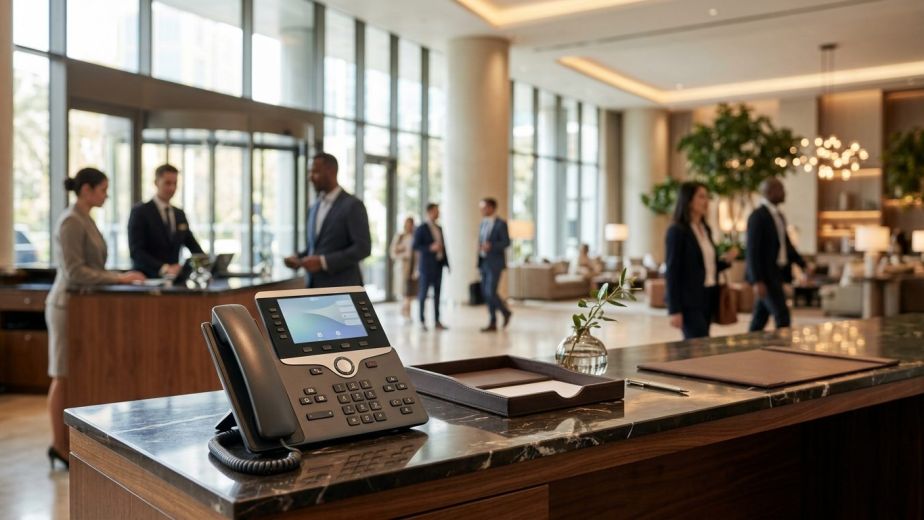
Choosing the right telephony architecture is critical for modern accommodation providers, and evaluating a hospitality cloud PBX against traditional on-site hardware is now a top operational priority. This engineering guide compares both architectures in detail, exploring how hoteliers can retain existing room cabling, automate property management workflows, and eliminate single points of failure. By understanding these architectural differences, hotel operations directors and IT teams can modernise their voice estates without disrupting the guest experience.
Key takeaways
- Cloud-hosted telephony eliminates on-premise server maintenance while providing centralised control across single or multi-property portfolios.
- Hotels do not need to rewire guestrooms; high-density FXS VoIP gateways bridge legacy two-wire analog cabling to modern IP backbones.
- Native cloud Property Management System (PMS) integrations automate guest check-in, room status codes, and call billing via standard APIs and middleware.
- Dual-WAN routing and local survivable branch appliances prevent operational disruption during external internet outages.
The Hospitality Voice Dilemma: Server Closets vs Cloud Flexibility
For decades, hotel telecommunications relied on massive, proprietary PBX cabinets bolted inside basement server rooms. These legacy appliances demanded expensive vendor maintenance contracts, dedicated cooling, and specialized punch-down blocks. Today, hotel operators face aging hardware reaching official end-of-life, leaving properties vulnerable to unpatchable software vulnerabilities and sudden board failures.
Furthermore, hospitality groups managing multiple locations struggle under fragmented infrastructure. Maintaining isolated PBX systems across distinct properties drives up overhead and prevents centralized guest reservation routing. Transitioning to modern hospitality cloud PBX solutions resolves this friction by centralizing call management within resilient, off-site data centers while standardizing operations across every location.
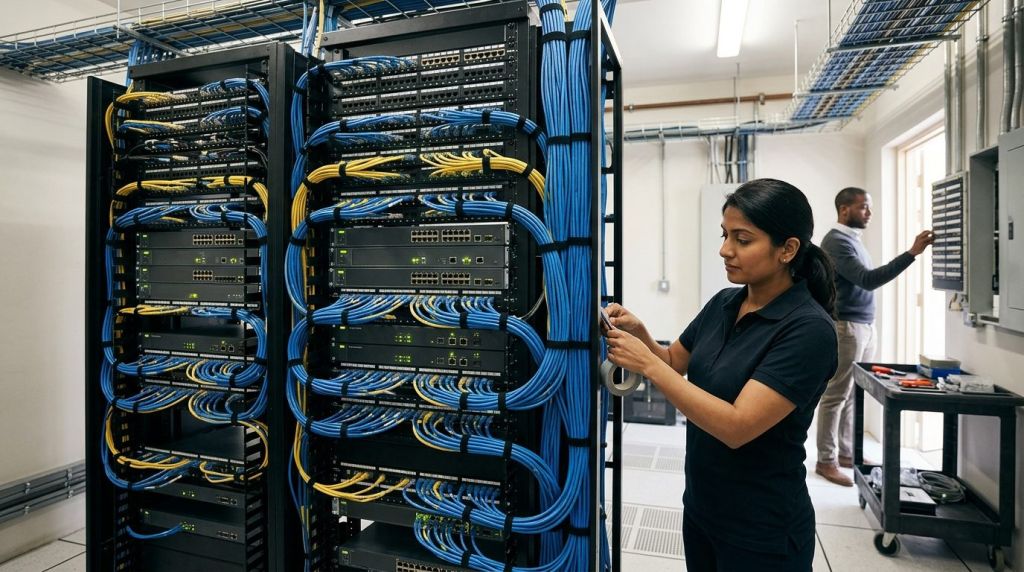
Architectural Breakdown: On-Premise PBX vs Hospitality Cloud PBX
Understanding the architectural divergence between on-site switchboards and cloud telephony helps IT leaders evaluate operational continuity, disaster recovery, and total resource consumption.
| Architectural Factor | Traditional On-Premise PBX | Hospitality Cloud PBX |
|---|---|---|
| Infrastructure Footprint | Heavy rack-mount servers, proprietary line cards, and dedicated UPS units. | Zero on-site telephony server footprint; runs in secure private or public cloud environments. |
| Scalability | Rigid capacity limits bounded by physical line cards and interface modules. | Dynamic, software-driven scalability to add extensions, trunks, or properties instantly. |
| Software Upgrades | Manual, high-risk firmware flashes requiring expensive on-site vendor callouts. | Centralized, non-disruptive cloud updates with automated rollbacks. |
| Multi-Site Administration | Disparate appliances managed individually via outdated console utilities. | Unified single-pane management portal for all regional and international sites. |
| Disaster Recovery | Vulnerable to local power cuts, water damage, and on-site hardware failure. | Geo-redundant cloud carrier failover with automatic routing to backup mobiles or call centers. |
Platforms like 3CX business communications and Yeastar business communications illustrate this shift by offering lightweight, virtualized environments. Rather than maintaining bespoke hardware appliances, hotels run standardized software stacks backed by modern enterprise operating environments such as Red Hat enterprise infrastructure, providing superior reliability and simpler operational maintenance.
Solving the Guestroom Cabling Problem: FXS Gateways and SIP Endpoints
The primary concern hotel general managers raise regarding a hospitality cloud PBX migration is the physical cost of rewiring guestrooms. Replacing category-3, two-wire analog cabling across hundreds of guestrooms with Cat6 structured ethernet is financially prohibitive and disruptive to hotel occupancy. Fortunately, an enterprise hotel telephone system does not require structured recabling to adopt cloud telephony.
Hoteliers resolve this through a practical hybrid design. The core platform resides in the cloud, while on-premise high-density FXS (Foreign Exchange Station) gateways sit inside existing distribution risers. Standard RJ21 telco connectors link the gateway directly to existing analog punch-down blocks. Consequently, the analog bedside phones remain fully functional, communicating over legacy copper pairs into local gateways that convert analog signals to encrypted SIP traffic destined for the cloud.
Meanwhile, hotel administration, front desk, concierge, and back-office teams transition to native SIP desktop endpoints or software applications. This hybrid model protects past capital expenditure in room furnishings while delivering modern features—such as visual voicemail, presence status, and centralized softphones—to operational departments.
PMS Integration in the Cloud: Bridging Cloud Voice with Opera Cloud, Mews, and Cloudbeds
A hospitality phone system cannot operate in isolation from property management operations. Guest satisfaction depends entirely on seamless data synchronization between front-of-house software and voice systems. Modern cloud phone system for hospitality deployments achieve this balance using lightweight middleware or direct REST API integrations.
Historically, property systems communicated using the legacy Micros Fidelio / FIAS protocol over local serial or TCP connections. Modern cloud telephony bridges this gap effortlessly. When selecting a cloud telephony architecture, hoteliers unlock immediate operational workflows:
- Automated Guest Check-In and Check-Out: As the PMS registers a guest arrival, the cloud PBX instantly unlocks the in-room telephone, unblocks outbound calling permissions, and updates caller display records with the guest’s name.
- Housekeeping and Room Status Updates: Cleaning staff dial brief feature codes from room handsets to update room readiness directly inside platforms like Oracle Hospitality Opera or Mews.
- Automated Wake-Up Services: Guests can schedule wake-up calls through the front desk or interactive voice prompts, generating automated confirmation logs for audit compliance.
- Minibar and Direct Billing: Staff enter automated consumption codes directly into the handset keypad, posting charges directly to guest folios without administrative delays.
For organisations managing enterprise applications on Oracle database platforms, cloud-native PBX connectors replace cumbersome physical converters, creating an agile, automated guest environment.
Ensuring Zero Downtime: Local Survivability, Emergency Routing, and E-911
Operations directors frequently ask: what happens to our guest phones if our primary internet connection drops? In hospitality, communications failure is not merely inconvenient; it poses severe safety and regulatory risks. Emergency room calling and internal communication must remain functional at all times.
To guarantee zero downtime, hotel IT leaders implement dual-WAN enterprise connectivity alongside Survivable Branch Appliances (SBAs). By coupling redundant optical fiber connections with software-defined traffic shaping through managed SD-WAN solutions, the property ensures automatic link failover if the primary provider falters. High-priority voice packets take precedence over guest Wi-Fi streams, eliminating jitter and dropped connections.
Furthermore, deploying an on-site survivable branch gateway ensures internal resilience. If total wide-area network failure occurs, the local gateway continues processing internal extensions, connecting room-to-front-desk calls and routing outbound emergency calls over local PSTN or GSM backup lines. This architecture ensures complete compliance with global life-safety standards and emergency dispatch mandates.
Preparing for Voice AI: Connecting Cloud PBX to Automated Guest Concierges
Hospitality technology is shifting quickly toward conversational automation. As reported by ET TravelWorld, major travel players are embracing automation, noting that Amex GBT launches an agentic AI tool to accelerate hotel sourcing. This broader industry push toward operational automation extends directly into guest-facing voice interfaces.
Legacy switchboards cannot interact with artificial intelligence platforms. Conversely, an API-first hospitality cloud PBX easily connects SIP trunks and interactive voice streams to specialized AI concierges. These intelligent systems handle frequent inquiries—such as breakfast hours, checkout times, luggage collection requests, and room service orders—relieving pressure on busy front-desk teams.
However, automation introduces critical operational considerations. As highlighted by TechBullion in their analysis, When Artificial Intelligence Answers the Phone: The Global Security Challenge Behind Intelligent Communications, routing enterprise voice through AI architectures demands rigorous endpoint validation, encryption, and data protection. Cloud PBX implementations must enforce strict network access controls, encrypt audio streams via SRTP, and restrict guest personal data exposure across connected models.
TCO and Procurement Checklist: Calculating the Return on Cloud PBX Migration
Evaluating the move to a hotel pbx cloud migration requires a clear-eyed total cost of ownership (TCO) analysis. On-premise PBX systems demand significant capital expenditure upfront, followed by recurring service retainers, proprietary spare parts procurement, cooling costs, and expensive telephony line rental.
Conversely, a hospitality cloud model transforms these erratic capital expenses into predictable operating expenditures. Hoteliers eliminate costly primary rate interfaces (PRI) and ISDN lines by adopting unified SIP trunking, scaling communication lines according to seasonal occupancy peaks. Below is an architectural checklist for operations leaders preparing to tender for a cloud telephony upgrade:
- Analog Infrastructure Assessment: Catalog the exact count of guestroom lines, elevator intercoms, and emergency panic buttons requiring FXS conversion.
- Bandwidth & Quality of Service (QoS): Validate WAN capacity, latency metrics, and network switch PoE budgets to sustain concurrent SIP calls alongside regular property traffic.
- PMS Compatibility: Confirm certified interoperability with your property management suite, whether via FIAS middleware or open cloud APIs.
- Resilience Strategy: Specify local survivability hardware, secondary failover circuits, and emergency line break-outs in the architectural tender.
- Managed Service SLAs: Partner with proven voice specialists capable of maintaining round-the-clock monitoring and remote support.
Conclusion: Transforming Hospitality Operations with Call Experts
Retaining rigid, end-of-life on-premise phone systems exposes hospitality properties to operational interruptions, rising maintenance fees, and frustrated guests. By contrast, migrating to an agile hospitality cloud PBX preserves existing bedside cabling investments while modernizing administrative workflows, enhancing guest service responsiveness, and future-proofing the enterprise for voice automation.
Call Experts designs, configures, and manages resilient telecommunication infrastructures tailored to the unique operational demands of international hospitality brands. Speak with our engineering team through our contact page to arrange a full infrastructure audit and custom migration blueprint for your property.
Frequently asked questions
Can our hotel switch to cloud PBX without replacing guestroom phones?
Yes. By deploying high-density FXS VoIP gateways on-premise, your existing two-wire analog cabling and guestroom phones connect directly to the modern cloud PBX over your local network, avoiding expensive room rewiring.
What happens to guest and emergency calls if our internet fails?
Enterprise cloud PBX deployments utilize dual-WAN failover alongside on-premise survivable gateways. If the primary internet circuit drops, calls route over backup links, while internal and emergency calls remain fully functional locally.
How does a cloud PBX synchronize with our Property Management System?
Modern cloud PBX systems integrate directly via cloud REST APIs or standard FIAS middleware. This automates guest caller identification upon check-in, unlocks room phones, captures minibar codes, and posts call billing to guest folios.
Why is cloud PBX more cost-effective for multi-property hotel groups?
Cloud telephony centralizes administration into a single management console, eliminating redundant server hardware, individual site maintenance contracts, and expensive proprietary line cards across distributed hotel portfolios.
Sources
- Amex GBT launches agentic AI tool to accelerate hotel sourcing — ET TravelWorld, 2026-10-19
- When Artificial Intelligence Answers the Phone: The Global Security Challenge Behind Intelligent Communications — TechBullion, 2026-10-19