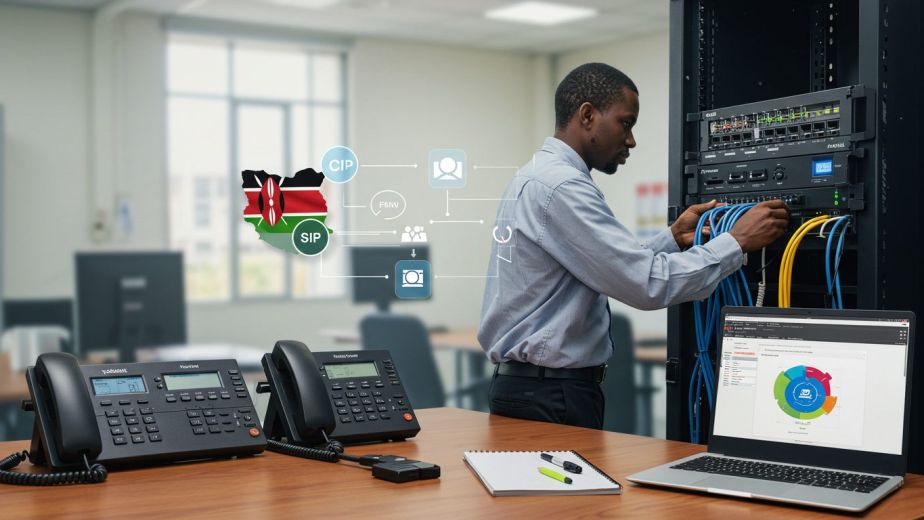
Understanding what is pbx phone system architecture in modern enterprise IT requires looking past the legacy telephone room in the office basement. A modern Private Branch Exchange serves as an intelligent, software-driven communications engine that manages internal directory routing, trunk connectivity, and multi-channel call queuing across distributed workforces. This guide breaks down how enterprise telephony operates, compares deployment frameworks, and explains how to secure operational continuity across your voice infrastructure.
Key takeaways
- A PBX controls signaling, internal extension routing, and Public Switched Telephone Network (PSTN) gateway connections across software and physical endpoints.
- Session Initiation Protocol (SIP) handles call setup and teardown, whilst Real-time Transport Protocol (RTP) delivers encrypted voice audio packets.
- Recent public cloud outages demonstrate why standalone productivity suites need redundant SIP trunks or dedicated PBX backbones for mission-critical continuity.
- Hybrid PBX deployments with Survivable Branch Appliances (SBAs) maintain local dialling even when broader internet uplinks drop.
Deconstructing the Core: What Is a PBX Phone System Today?
In historical telephony, a Private Branch Exchange was a physical switchboard or massive hardware cabinet filled with Time Division Multiplexing (TDM) cards and copper pairs. Today, when evaluating what is pbx phone system technology in modern IT environments, it is best understood as a virtualised communications operating system. Modern platforms, such as 3CX and Yeastar, run on standard x86 servers, lightweight appliances, or private cloud hypervisors.
A modern PBX acts as the authoritative central exchange for an organisation. It manages internal short-code extensions, routes calls across departments, and arbitrates connections between internal users and external carriers. Crucially, a business phone system is not simply an app feature inside a generic office software bundle. While collaborative messaging tools handle internal chats and ad-hoc video meetings, an enterprise PBX provides carrier-agnostic dial plans, automated compliance recording, and resilient trunk switching.
Fundamentally, determining what is pbx phone system infrastructure today comes down to control over call processing logic and independent carrier connectivity. Organisations maintain complete ownership of their dial paths, routing policies, and security parameters without being locked into single-tenant software ecosystems.

How Does a PBX Phone System Work? The Technical Signaling Core
To understand how does a pbx phone system work across modern networks, it helps to examine the separation between call signaling and voice media transport. When an employee dials an extension or external number, the system initiates a structured sequence governed by open telecommunications standards established by the Internet Engineering Task Force (IETF).
First, Session Initiation Protocol (SIP) handles the signaling layer. The user endpoint—whether a physical Yealink desk phone, a Fanvil console, or a desktop softphone—sends a SIP INVITE request to the PBX server. The PBX evaluates dial rules, user permissions, time-based office schedules, and caller identity. Once authentication completes, the PBX signals the receiving party.
Second, once the recipient answers, the voice stream switches protocols. The PBX or Session Border Controller (SBC) negotiates the audio session via the Real-time Transport Protocol (RTP), commonly secured through SRTP encryption. Voice packets flow directly between endpoints or through an internal media proxy using low-bandwidth codecs like G.711 or Opus.
Key Architectural Components
- PBX Switching Core: The central software application managing registrar duties, dial plans, hunt groups, and feature logic.
- SIP Trunks: Virtual broadband telephone connections delivered by carriers over optical fibre or dedicated data links, replacing physical ISDN PRI circuits.
- Session Border Controller (SBC): A specialised network appliance or software firewall designed to validate SIP traffic, prevent toll fraud, and protect the PBX from denial-of-service attacks.
- Enterprise Endpoints: IP hardware phones, conference stations, softphone applications, and mobile clients registered securely to the PBX core.
Cloud PBX vs On Premise PBX and Hybrid Architecture
When deciding what is pbx phone system deployment best aligns with your governance requirements, the choice between on-premises appliances, pure cloud, and hybrid models is decisive. Each model balances operational control, capital expenditure, and resilience differently.
| Architecture Model | Primary Advantages | Potential Constraints | Ideal Use Case |
|---|---|---|---|
| On-Premises IP PBX | Full data sovereignty, zero recurring cloud hosting fees, continues local dialing without internet. | Requires local server maintenance, hardware lifecycle management, and on-site backup power. | Hospitals, bank branches, industrial sites, and regions with volatile WAN links. |
| Cloud-Hosted PBX | Zero on-site server footprints, effortless multi-location expansion, managed patching. | Dependent on continuous WAN connectivity; subject to cloud infrastructure outages. | Distributed professional service firms, dynamic real estate agencies, multi-country sales teams. |
| Hybrid PBX Architecture | Centralised cloud management paired with local branch failover gateways (SBAs). | Slightly higher initial network architecture design complexity. | Enterprises balancing cloud agility with life-safety or transactional continuity mandates. |
An on-premises deployment gives IT teams granular control over their media storage and network routing. However, pure cloud-hosted platforms simplify administration for multi-location teams. This architecture allows staff to access unified communications regardless of physical location.
For mission-critical operations, the hybrid deployment offers the strongest survivability profile. By deploying a Survivable Branch Appliance (SBA) or an edge gateway at branch offices, local desks can continue inter-office dialing and emergency PSTN routing even if the primary data link to the central cloud server experiences downtime.
Business Telephony Failover: Lessons from the Cloud Collaboration Blackout
Many enterprises recently adopted a strategy of consolidating all corporate voice inside generalised cloud collaboration suites. However, relying entirely on a single multi-tenant software ecosystem creates systemic risk. Real-world incidents demonstrate the severe consequences of this single point of failure.
As reported by Telecom Reseller / Technology Reseller News, a widespread Microsoft Teams, Outlook and Microsoft 365 outage disrupted enterprise communications on 12 November 2026. On the same day, reporting by CU Today highlighted that this massive Microsoft outage disrupted business communications and raised acute operational concerns for credit unions and banks relying on cloud channels for basic operational workflows.
When an all-in-one productivity suite fails, organisations lose email, internal chat, and PSTN calling simultaneously. This operational paralysis leaves staff unable to contact emergency services, verify client transactions, or manage customer enquiries. Knowing what is pbx phone system reliability in practice allows engineering teams to implement active-passive trunk failover, ensuring phones stay up when collaboration suites go dark.
Resilient enterprises resolve this dilemma through hybrid voice integration. By pairing 3CX business phone systems or Yeastar platforms with independent multi-carrier SIP trunking, companies maintain complete voice autonomy. Using technologies like Microsoft Teams Direct Routing, staff can use familiar collaboration interfaces daily, while the underlying enterprise PBX instantly re-routes incoming calls to mobile apps, standby desk phones, or alternative carriers if the primary cloud tenant fails.
Core Enterprise PBX Features That Protect Operations
Consumer voice applications and lightweight virtual numbers lack the automated call processing engines required by demanding operational workflows. Enterprise platforms deliver specialised business telephony failover tools and workflow integrations that protect revenue and operational integrity.
- Intelligent Interactive Voice Response (IVR): Multi-level auto-attendants guide callers efficiently using time-of-day condition tables, holiday schedules, and dynamic skill routing.
- Advanced ACD Call Queues: Automatic Call Distribution manages inbound call surges by dynamically distributing callers across available agents using strategies like round-robin, longest-idle, or priority weighting.
- Call Recording and Compliance: Automated call recording engines archive conversations securely on local network-attached storage or encrypted object storage, fulfilling strict regulatory guidelines.
- CRM and ERP Integrations: Real-time screen pops surface account records automatically when a client calls, logging interaction history inside systems like Salesforce, Microsoft Dynamics, or bespoke databases.
- Enterprise VoIP Security: Robust IP PBX deployments secure the perimeter by encrypting SIP signaling via Transport Layer Security (TLS) and protecting the voice stream using Secure Real-Time Transport Protocol (SRTP).
Sizing IP PBX Architecture and Network Infrastructure
Deploying a successful voice environment requires matching the system’s capacity to realistic operational usage rather than simply tallying the total number of staff. The most cost-effective metric for sizing a modern PBX is concurrent calls (simultaneous incoming, outgoing, and internal calls active at a single moment).
A professional firm with 100 employees rarely requires 100 active telephone lines. In standard corporate environments, a ratio of one concurrent call path for every three to four employees is typical. However, high-volume contact centres, medical triage desks, and hospitality reservations desks frequently operate at a one-to-one ratio.
Underlying data transport must also be properly provisioned. Voice over IP packets are exceptionally sensitive to jitter, packet loss, and latency. Even minimal packet loss above one percent degrades voice clarity noticeably. Engineering teams should deploy managed SD-WAN and establish strict Quality of Service (QoS) tagging (such as DSCP Expedited Forwarding) across local network switches and firewalls. This guarantees that real-time voice packets always take priority over large file downloads and background cloud backups.
Building Voice Resilience with Call Experts
Deciding on the correct enterprise voice architecture requires a practical balance of business continuity, feature flexibility, and long-term operating costs. A truly resilient communications system protects your organisation from unexpected public cloud downtime, safeguards regulatory compliance, and ensures seamless reachability across every branch office.
Call Experts designs, installs, and manages enterprise-grade IP PBX and cloud communications platforms tailored to your operational workflows. Whether configuring high-availability on-premises PBXs, building cloud voice platforms, or integrating automated failover for Microsoft 365 environments, our engineers ensure your voice network remains resilient. To review your infrastructure or request a bespoke voice architecture proposal, contact our communications team today.
Frequently asked questions
What is the difference between VoIP and a PBX?
VoIP (Voice over Internet Protocol) is the transmission technology that converts analogue voice into digital packets. A PBX (Private Branch Exchange) is the intelligent routing engine that manages extensions, call queues, IVRs, and external carrier trunks. Modern PBXs use VoIP technology to deliver calls across enterprise data networks.
Can our company keep existing phone numbers when migrating to a new PBX?
Yes. Number porting regulations allow businesses to transfer existing direct inward dial (DID) numbers, toll-free lines, and main pilot numbers from legacy copper or ISDN circuits over to modern SIP trunk providers without interrupting incoming customer communications.
Why shouldn't an enterprise rely solely on Microsoft Teams for voice calling?
Relying exclusively on cloud collaboration suites introduces a single point of failure during multi-tenant outages. Integrating Teams with an independent PBX via Direct Routing allows businesses to maintain phone service and switch carrier paths if the cloud provider experiences downtime.
How much internet bandwidth does an IP PBX require per call?
A standard, uncompressed VoIP call using the common G.711 codec uses roughly 85 to 100 kbps of bandwidth in both directions, including network overhead. Compressed, high-efficiency codecs such as G.729 or Opus reduce this requirement to approximately 30 to 40 kbps per concurrent call.
Sources
- Microsoft Teams, Outlook and Microsoft 365 Outage Disrupts Enterprise Communications — Telecom Reseller / Technology Reseller News, 2026-11-12
- Massive Microsoft Outage Disrupts Business Communications, Raises Concerns For Credit Unions and Banks — CU Today, 2026-11-12