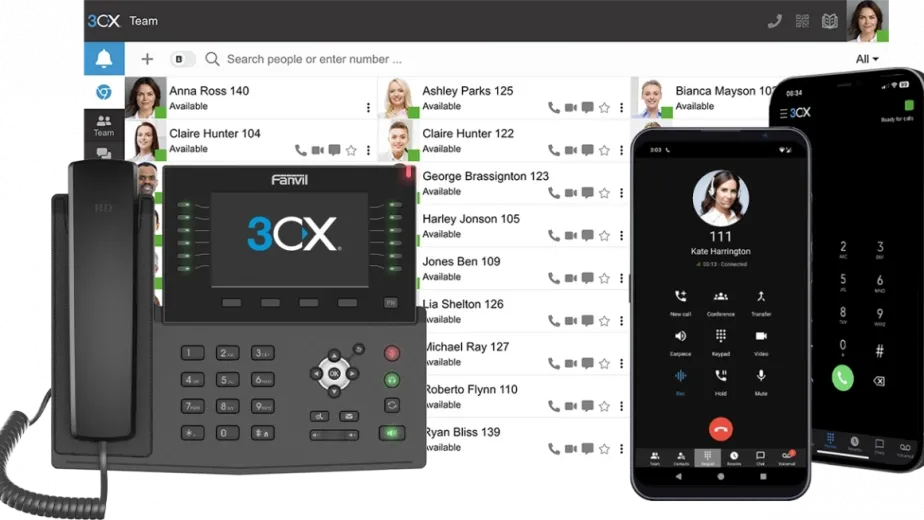
Modern enterprises evaluating 3cx business phone systems face a pivotal architectural choice between rigid per-seat subscription models and flexible concurrent call licensing. Deploying the right communication backbone requires balancing infrastructure sizing, reliable hosting topologies, and resilient hardware integrations to ensure uninterrupted operations.
This technical guide details how to calculate capacity, evaluate hosting environments, and securely integrate voice trunks across distributed corporate estates.
Key takeaways
- How simultaneous call licensing reduces recurring overhead compared to standard per-user software subscriptions.
- Engineering sizing ratios to accurately calculate concurrent call capacity across diverse operational workloads.
- Architectural trade-offs between dedicated private cloud instances, regional virtual private servers, and on-premises appliances.
- Hardware provisioning protocols for IP endpoints, session border controllers, and legacy analogue gateways.
- Critical voice hardening measures including SIP TLS, SRTP encryption, and network quality of service tagging.
The Commercial Case: 3CX vs Per-User VoIP Architectures
Legacy unified communications providers traditionally bill on a per-seat basis. Under that framework, an enterprise pays a recurring fee for every registered user regardless of their actual call activity. As noted in a review of 8×8 Work by PCMag UK, established UCaaS platforms offer robust enterprise capabilities, yet per-user models can impose substantial ongoing costs when extended across large workforces where many staff make few external calls.
In contrast, 3cx business phone systems rely on simultaneous call licensing. This model permits unlimited extension creation while licensing only the maximum number of concurrent inbound, outbound, and internal calls traversing the PBX at any single moment. For professional services firms, educational institutions, or distributed retail networks with 200 staff, concurrent peak usage rarely exceeds 32 or 64 active calls.
Evaluating 3cx vs per-user voip highlights significant operational savings. Instead of paying licensing fees for passive desk phones in meeting rooms, break areas, or back-office departments, businesses license only their true operational traffic channels. This shift eliminates seat-based penalties while delivering unified communications across desktop clients, web portals, and mobile devices.

Calculating Capacity with a 3CX Simultaneous Call Calculator Model
Accurate enterprise sizing prevents call blockage during peak business hours without overprovisioning underlying system resources. Rather than relying on guesswork, network engineers use structured concurrency ratios tailored to specific departmental activities.
A practical 3cx simultaneous call calculator framework balances user headcount against empirical traffic patterns:
- Standard Professional Services (1:3 to 1:4 ratio): In corporate settings such as law practices, consultancies, or engineering firms, phone usage remains intermittent. A firm with 120 users typically requires a 32-simultaneous-call tier.
- High-Velocity Commercial Teams (1:2 ratio): Recruitment agencies, active sales desks, and financial brokerage teams maintain frequent external lines. An office of 60 brokers requires at least 32 concurrent channels.
- Blended Customer Support and Contact Centres (1:1 ratio): Dedicated support teams operating persistent inbound and outbound channels require full parity. A 48-agent contact desk demands a minimum of 48 to 64 simultaneous calls to accommodate call queues and queue-overflow routing.
When calculating capacity, administrators must remember that internal extension-to-extension traffic, automated IVR attendants, parked calls, and mobile softphone bridging consume simultaneous call capacity. Factoring in a 20 percent buffer ensures seasonal spikes and emergency communications never encounter busy signals.
Evaluating Enterprise 3CX Hosting Options
Choosing the correct deployment topology directly influences audio clarity, round-trip packet latency, and overall operational control. Organizations must evaluate three primary 3cx hosting options against their connectivity profiles and governance policies.
| Deployment Topology | Best Suited For | Key Operational Advantages | Architectural Trade-offs |
|---|---|---|---|
| Public Cloud (Azure / AWS) | Multi-site international teams with distributed hybrid workers. | High availability, global scaling, automated snapshots, and resilient infrastructure. | Requires robust ingress internet connectivity and ongoing hyperscaler compute fees. |
| Regional Private VPS | Enterprises demanding data sovereignty and sub-20ms local latency. | Direct routing peering, sovereign compliance, and localized carrier trunking. | Demands regional data centre redundancy and monitored hypervisor uptime. |
| On-Premises Appliance | Sites with unreliable wide area networks, manufacturing, or hospitality. | Complete local survivability; internal calls function during WAN drops. | Requires physical hardware maintenance, rack space, and local power backup. |
For organizations deploying across East Africa and international hubs, hosting 3CX on dedicated Microsoft Azure infrastructure or high-performance East Africa Virtual Private Servers provides optimal audio quality by keeping voice packets within low-latency regional exchanges. Maintaining round-trip network latency below 50 milliseconds and packet jitter under 10 milliseconds prevents jitter buffer exhaustion and voice clipping.
Where physical branch survivability is required, deploying a local 3CX Session Border Controller (SBC) consolidates all branch extension traffic across a single encrypted port. This eliminates complex firewall traversal while preserving internal calling during wide area connection dropouts.
Hardware Interoperability: Endpoints, Intercoms, and Gateways
Enterprise deployments frequently involve a mix of physical desktop phones, executive conferencing units, and door entry systems. Selecting certified hardware ensures smooth provisioning and dependable day-to-day operation.
Yealink enterprise phones and Fanvil commercial endpoints represent standard deployment choices for modern 3CX environments. These devices support secure automated provisioning through Redirection and Provisioning Services (RPS). When plugged into an enterprise voice VLAN, the handset securely queries the provisioning server, authenticates, and applies firmware policies and extension mappings without manual intervention.
For facilities incorporating legacy equipment, analogue telephony adapters (FXS gateways) bridge elevator emergency lines, warehouse horns, and legacy fax machines directly into the central PBX. Furthermore, organizations can integrate certified SIP video intercoms into corporate building access systems, enabling security teams to screen visitors directly from desktop handsets or mobile apps.
Enterprise Voice Security and Operational Resilience
Voice infrastructure is a prime target for credential stuffing, toll fraud, and unauthorized trunk access. Drawing on corporate governance lessons, Financier Worldwide highlights how high-reliability industries shift from static compliance checklists toward genuine digital risk resilience. Applying this posture to voice architecture requires layered defensive controls.
A resilient voice implementation mandates the following safeguards:
- SIP TLS and SRTP Encryption: Encrypt all signalling via Transport Layer Security and media streams with Secure Real-time Transport Protocol to prevent call interception.
- Dynamic IP Blacklisting: Configure 3CX intrusion prevention parameters to instantly ban IP addresses exhibiting failed authentication attempts or anomalous registration requests.
- Trunk Interconnect Whitelisting: Lock down sip trunk integration for 3cx by restricting SIP signaling exclusively to the verified IP addresses of your authorized telecom carrier.
- Automated Encrypted Backups: Schedule daily, off-site system backups containing system configuration, call detail records, and voicemails, encrypted with enterprise keys.
- Toll Fraud Restrictions: Disable outbound international dialling profiles by default, requiring granular extension permissions and destination PIN controls.
Network engineers should implement enterprise networking controls that separate telephony into a dedicated voice VLAN. Tagging packets with Differentiated Services Code Point (DSCP) 46 Expedited Forwarding (EF) ensures that core routers and managed switches prioritize voice data ahead of standard business web traffic.
CRM Integration, AI Workflows, and 3CX Enterprise Licensing
Selecting 3cx enterprise licensing unlocks advanced routing capabilities and workflow automations that bridge telephony directly into enterprise productivity stacks. Deep integration with directory services and business applications transforms standalone calling into an intelligent communication hub.
Native synchronization with Microsoft 365 allows real-time presence synchronization between platforms, unified user directory lookups, and automated calendar-based routing rules. When integrated with customer relationship platforms such as Salesforce or HubSpot, inbound calls trigger automated screen pops detailing caller history before the agent answers, while outbound click-to-dial streamlines operational workflows.
Beyond traditional telephony, the platform manages inbound WhatsApp business messages and website live chats through a single omnichannel queue. Advanced enterprise deployments can also route recorded audio streams through secure transcription engines, converting customer interactions into searchable text records to maintain compliance and improve service quality.
Implementation Checklist for 3CX Business Phone Systems
Before procuring hardware or migrating telephone lines, technical teams must conduct a thorough readiness review. Use this step-by-step checklist to ensure a seamless rollout:
- Bandwidth & Codec Audit: Verify symmetrical upstream and downstream bandwidth, allowing 100 kbps per concurrent G.711 call or 40 kbps per G.729 compressed channel.
- Carrier Trunk Verification: Confirm that your telecom provider supports direct IP-authenticated or registration-based SIP trunking with RFC-compliant delivery.
- Firewall Configuration: Open required outbound UDP/TCP ports for RTP audio and SIP signalling while keeping inbound PBX management interfaces restricted behind secure VPNs.
- VLAN & PoE Readiness: Ensure all edge network switches feature Power over Ethernet (PoE) and automated Voice VLAN assignment via LLDP-MED.
- High Availability Configuration: For mission-critical operations, configure active-passive PBX failover instances capable of assuming primary roles within seconds of hardware degradation.
Partnering with an experienced system integrator like Call Experts ensures your architecture is engineered for low latency, tight security, and high uptime. From initial network audits to ongoing lifecycle management, working with verified specialists minimizes migration risks and keeps operations running smoothly.
Achieving Long-Term Voice Continuity
Deploying 3cx business phone systems offers organizations substantial commercial savings and architectural flexibility over rigid, per-seat SaaS alternatives. By accurately calculating simultaneous call concurrency, selecting the optimal hosting model, and enforcing strict voice security standards, IT leaders can establish a high-performance communication platform designed for growth.
Whether modernising an outdated PBX or consolidating multi-site telephony into a resilient private cloud, success depends on meticulous network preparation and disciplined engineering. For enterprise sizing advice, carrier trunk integration, or an initial architectural review, consult with the engineering team at Call Experts.
Frequently asked questions
What is the primary difference between simultaneous call and per-user VoIP pricing?
Simultaneous call licensing charges only for the maximum number of active calls happening at one time, allowing unlimited extensions. Per-user VoIP models charge a flat recurring fee for every registered employee, which increases operational costs for staff with low phone usage.
How do I choose between cloud hosting and on-premises deployment for 3CX?
Cloud hosting provides high availability, off-site redundancy, and simplified management for distributed or remote teams. On-premises deployments suit facilities with poor internet infrastructure or strict local survivability requirements, ensuring internal calls function even during wide-area network drops.
Can I keep my existing IP desk phones when migrating to 3CX?
Most standard SIP handsets from major manufacturers like Yealink and Fanvil are fully compatible with 3CX. Handsets can be automatically provisioned through secure redirection services, though older legacy proprietary models may require testing or analogue adapters.
What network requirements are needed to maintain enterprise voice quality?
Deployments require round-trip latency below 50ms, jitter under 10ms, and packet loss under 1%. Networks should incorporate a dedicated voice VLAN, Power over Ethernet switches, and Quality of Service tagging using DSCP 46 EF to prioritize voice packets.
Sources
- 8×8 Work Review: A Workhorse VoIP With Powerful Business Features — PCMag UK, 2026-11-10
- Compliance to resilience: lessons from high-reliability industries on managing digital risk — Financier Worldwide, 2026-11-10