Executing an enterprise 3cx telephone system migration requires precise technical coordination to prevent disruption to daily business operations. When migrating away from ageing hardware or rigid hosted platforms, IT teams must balance network provisioning, trunk routing, and user onboarding seamlessly. This guide details a battle-tested engineering blueprint for managing your cutover with zero unplanned downtime.
Key takeaways
- Conduct a granular inventory of both digital routes and mission-critical analogue endpoints before touching any infrastructure.
- Adopt the right deployment architecture and 3CX Session Border Controller (SBC) topology to eliminate complex firewall configurations and NAT traversal failures.
- Enforce strict perimeter security, call encryption, and administrative access controls to protect voice streams from modern edge attacks.
- Coordinate SIP trunk cutover schedules and DNS changes during off-peak windows with verified rollback mechanisms.
Pre-Migration Audit: Mapping Extensions, DIDs, and Call Logic
Every successful telephony project starts with exhaustive discovery. Before provisioning your new 3CX telephone system, you must document your existing voice footprint in detail. Many organisations discover dormant routes, unassigned direct inward dialling (DID) ranges, and forgotten hunt groups only when inbound callers hit a dead end. Avoid this pitfall by building a comprehensive translation table of every current extension, external number, and call-handling rule.
Special attention must be paid to analogue devices. While desktop users easily transition to IP handsets or softphones, critical systems often rely on legacy analogue lines. These include lift emergency phones, door access intercoms, physical fax machines, and alarm diallers. Identify which analogue endpoints will require dedicated analogue telephone adapters (ATAs) or gateway hardware. Review our enterprise VoIP migration checklist for additional auditing frameworks.
Equally critical is auditing your local and wide area network (WAN) readiness. Real-time voice traffic cannot tolerate the jitter or latency that standard web browsing easily absorbs. Ensure your network switches support Differentiated Services Code Point (DSCP) Quality of Service (QoS) tagging. Prioritise voice packets at Layer 3, and verify you have sufficient dedicated bandwidth to handle peak concurrent calls under standard codecs like G.711 and bandwidth-saving options like G.729.

Architecting the Platform: Cloud, Hosted, or On-Premise
Determining where your voice server resides is a foundational choice in your 3cx telephone system migration. Organisations typically evaluate three models: managed private cloud, public cloud virtual machines, or on-premise appliances. High-security environments or facilities with intermittent internet connectivity may favour local on-premise hardware. Conversely, enterprises prioritising geographic resilience and simplified maintenance often select managed cloud infrastructure.
A major commercial advantage of 3CX is its simultaneous call (SC) licensing structure. Unlike traditional UCaaS vendors that charge high recurring per-seat fees, 3CX licenses system capacity based on the peak number of concurrent internal and external calls. In its market analysis, Seeking Alpha highlighted how cloud migration headwinds impact software renewals across enterprise SaaS segments. Moving to a concurrent-call PBX model protects organisations from ballooning operational expenditure as headcount expands.
To help guide this infrastructure selection, consider how core business factors align with each model:
| Architecture Model | Primary Advantages | Key Operational Demands | Ideal Use Case |
|---|---|---|---|
| Managed Private Cloud | Guaranteed compute resources, high availability, offsite redundancy | Requires dedicated interconnect or robust SD-WAN | Multi-site enterprises, distributed professional services |
| Public Cloud (Azure/AWS) | Rapid provisioning, granular access controls, native cloud snapshots | Ongoing cloud consumption monitoring and maintenance | Hybrid enterprises already invested in hyperscaler stacks |
| On-Premise Appliance | Local survivability during ISP outages, direct LAN speed | Hardware lifecycle management, physical power protection | Industrial plants, healthcare centres, high-density campuses |
Network Edge and Security Hardening: Deploying 3CX SBCs
Modern enterprise communications must withstand relentless automated probing at the network boundary. Telephony infrastructure represents an attractive vector for threat actors seeking toll fraud, data harvesting, or corporate eavesdropping. As EC-Council emphasised in its network security analysis, robust perimeter defense and endpoint segmentation are vital for corporate resilience. Furthermore, MSSP Alert reported that threat actors targeted Check Point servers in a global hacking campaign, demonstrating that internet-facing enterprise infrastructure requires relentless hardening.
To protect your system without introducing fragile firewall pinholes, deploying the 3CX Session Border Controller is essential. The SBC bundles all SIP signalling and RTP audio streams across a remote branch into a single encrypted tunnel using TLS and SRTP. This approach bypasses asymmetric NAT traversal problems, eliminates one-way audio anomalies, and ensures crisp voice delivery across remote offices. Dedicated router phones from supported manufacturers can also serve as embedded SBC endpoints for micro-branches.
Hardening the central PBX console requires an equally disciplined posture. Change default administrative management ports, enforce multi-factor authentication (MFA) across all administration accounts, and restrict management console access to trusted static IP ranges. Turn on 3CX’s automated IP blacklisting features to instantly drop traffic from endpoints triggering repeated SIP authentication failures. Detailed perimeter configurations are outlined in our guide to enterprise VoIP security.
Replicating Business Logic: IVR Routing and Integrations
Technical stability means little if your customer experience breaks during cutover. Replicating legacy PBX business logic demands meticulous recreation of digital receptionists, ring groups, and out-of-hours queues. Map your auto-attendants visually before configuring the new digital receptionist menus in the 3CX dashboard. Record professional greeting prompts in uncompressed WAV format (16-bit, 8 kHz, mono) to guarantee pristine acoustic quality across all handsets.
Configure call queues with intelligent routing behaviours tailored to each department. Implement round-robin, longest-waiting, or skills-based routing depending on staff roles. For contact centres, establish queue failover destinations so callers never become stranded during sudden call spikes. Incorporate holiday schedules and time-of-day office hours within 3CX global rules, freeing operational staff from manual switch toggles.
Modern deployments should also bridge voice with enterprise productivity tools. Integrating 3CX with Microsoft 365 enables real-time directory synchronisation, single sign-on, and calendar-based presence updates. Connecting your PBX to your corporate CRM system via native webhooks or official connectors enables automatic contact lookups, inbound screen pops, and call-journal recording. This transforms basic voice calls into valuable customer intelligence records.
Carrier Coordination: SIP Trunk Porting and Redundancy
Managing carrier cutover timelines is frequently the most delicate phase of a 3cx telephone system migration. Regulatory number porting processes involve multiple telco handshakes, and minor documentation discrepancies can stall orders for weeks. To maintain strict control, establish a clear execution sequence with your upstream carriers:
- Carrier validation: Obtain recent Customer Service Records (CSR) from your existing provider to verify billing names, addresses, and service IDs.
- Dual-trunk provisioning: Stand up your new primary SIP trunk on the 3CX platform several weeks ahead of the porting date.
- Test number verification: Order temporary direct dial numbers on the new trunk to validate inbound DTMF routing, outbound caller ID presentation, and audio clarity.
- Porting schedule: Secure a mutually agreed cutover date from the losing and gaining carriers, requesting an early morning or weekend window.
- Call forwarding fallback: Ensure your losing carrier can immediately configure unconditional call forwarding to a temporary lead number on the new trunk if the port encounters delays.
Never rely on a single upstream voice route. Enterprise resilience dictates establishing secondary SIP trunks from an alternate, physically distinct carrier. Configure secondary outbound routes within 3CX with automatic failover triggers. If the primary trunk suffers packet loss or upstream peer termination, outbound calls immediately redirect through the backup trunk without user intervention.
The Enterprise PBX Cutover Plan: Testing and Deployment
When the cutover day arrives, following a disciplined execution checklist eliminates chaos. The transition must follow a phased strategy that leaves nothing to chance. Below is the operational sequence required to carry your organisation smoothly through cutover day.
Step 1: Departmental Pilot Validation
Begin by onboarding an isolated, non-critical department—such as internal IT or facilities—onto the 3CX platform one to two weeks prior to the wider rollout. Test internal calling, queue transfer procedures, voicemail-to-email delivery, and mobile applications over cellular networks. This pilot surfaces edge-case network anomalies and allows you to refine end-user onboarding documentation.
Step 2: Endpoint Provisioning via RPS and SBC
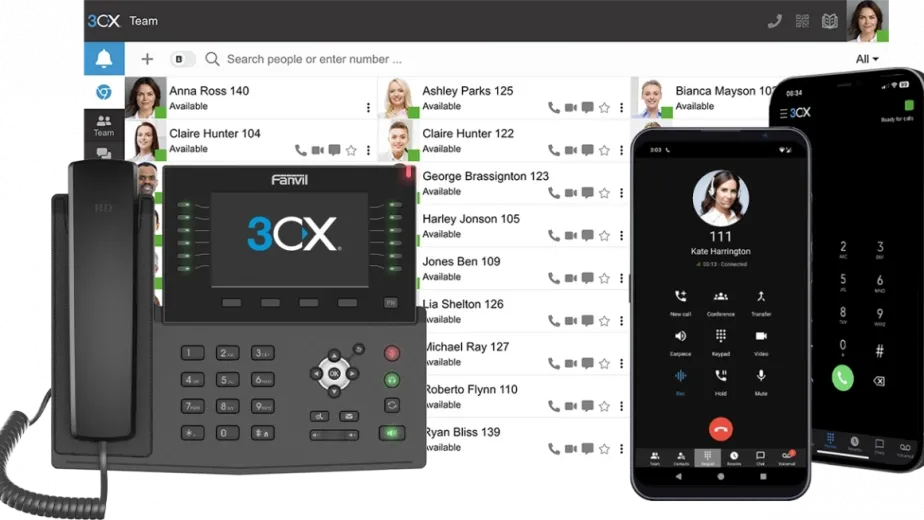
Avoid touching desk phones manually. Leverage the 3CX Reseller Provisioning Service (RPS) to bind hardware MAC addresses directly to target user extensions in the cloud. When field technicians unpack and connect Yealink or Fanvil handsets on the local LAN, the devices automatically pull their configuration files over HTTPS through the local 3CX SBC tunnel. Distribute softphone invite links containing pre-configured QR codes, allowing hybrid workers to configure desktop and mobile softphones with one scan.
Step 3: Off-Peak Switch and Carrier Release
Execute the carrier porting switch during an agreed off-peak maintenance window. Once the losing carrier releases the DID block and the gaining provider registers the numbers, trigger an immediate series of test calls across every direct dial range. Confirm both inbound call delivery and outbound emergency service routing. A comprehensive reference plan can be reviewed in our managed telephony services guide.
Step 4: Real-Time Audio Metric Auditing
Monitor real-time Mean Opinion Score (MOS) metrics within the 3CX call logging console immediately following the switch. Industry standards defined by the International Telecommunication Union (ITU) classify voice quality on a 1 to 5 scale, where scores above 4.0 represent toll-quality audio. If MOS scores drop below 3.5, immediately audit local network switch queues, look for unclassified WAN saturation, or adjust codec priorities.
Post-Cutover Governance: Monitoring and Resilience
Achieving dial tone on day one is only the halfway mark. Long-term operational stability demands ongoing PBX governance, automated data protection, and routine system maintenance. Telephone systems should not be treated as static utility appliances; they require proactive lifecycle administration.
Schedule automated, encrypted nightly backups within 3CX, transmitting system states and call logs to independent cloud storage destinations such as Microsoft Azure or an external SFTP repository. Establish regular firmware update validation protocols to ensure IP handsets receive stable, tested software builds. For further technical specifications on scaling and maintaining high-capacity systems, review our 3CX business phone systems guide.
Review Call Detail Records (CDR) weekly to track extension utilisation patterns, dropped call rates, and trunk usage peaks. These analytics inform ongoing simultaneous call capacity adjustments, ensuring your organisation never pays for idle licences while avoiding peak-hour busy signals. Engaging an experienced managed technology partner like Call Experts ensures your voice infrastructure benefits from round-the-clock monitoring, firmware governance, and rapid operational support.
Executing Your Enterprise Voice Modernisation
Carrying out a structured 3cx telephone system migration frees your enterprise from obsolete on-premise hardware, unpredictable per-user licencing bills, and inflexible communications. By systematically executing an exhaustive discovery audit, deploying robust SBC security tunnels, and coordinating carrier handshakes with precision, IT leaders can modernise enterprise voice without business interruption.
Whether you manage a single busy office or a distributed multi-site network, success lies in engineering preparation and disciplined execution. If your team is evaluating an upcoming PBX cutover or seeking guidance on system sizing, contact the team at Call Experts to design and deliver a seamless telephony transition tailored to your operational requirements.
Frequently asked questions
How long does a typical 3CX telephone system migration take?
A standard enterprise migration takes two to four weeks. This timeframe encompasses discovery audits, network configuration, 3CX SBC provisioning, and user acceptance testing. The primary timing variable is carrier number porting, which often requires two to three weeks depending on local regulatory requirements and carrier responsiveness.
Can we keep our existing analogue devices during a 3CX migration?
Yes. Analogue endpoints like door intercoms, lift emergency phones, and physical faxes connect directly into 3CX using supported Analogue Telephone Adapters (ATAs) or gateway appliances. These adapters convert legacy analogue signals into standard SIP traffic, preserving existing physical wiring while centralising voice management.
How does 3CX licensing prevent communication cost overruns?
Traditional cloud telephony providers charge a recurring monthly licence for every individual user account. 3CX prices its platform based on concurrent simultaneous calls shared across the entire organisation. Because only a fraction of employees make external calls simultaneously, this licensing model significantly reduces annual enterprise expenditure.
What is the primary role of the 3CX Session Border Controller (SBC)?
The 3CX SBC connects remote branch endpoints to the central PBX over a single, encrypted TLS/SRTP tunnel. It eliminates NAT traversal issues, handles audio stream routing locally across desk phones to preserve WAN bandwidth, and simplifies deployment by removing the need for complex firewall port forwarding.
Sources
- Enterprise Network Security: Essential Strategies for Cyber Defense – Cybersecurity Exchange — EC-Council, 2026-11-27
- Threat actor targets Check Point servers in global hacking campaign — MSSP Alert, 2026-11-26
- Docusign Earnings Preview: Cash-Rich Buybacks Vs. Cloud Migration Headwinds (NASDAQ:DOCU) — Seeking Alpha, 2026-11-26