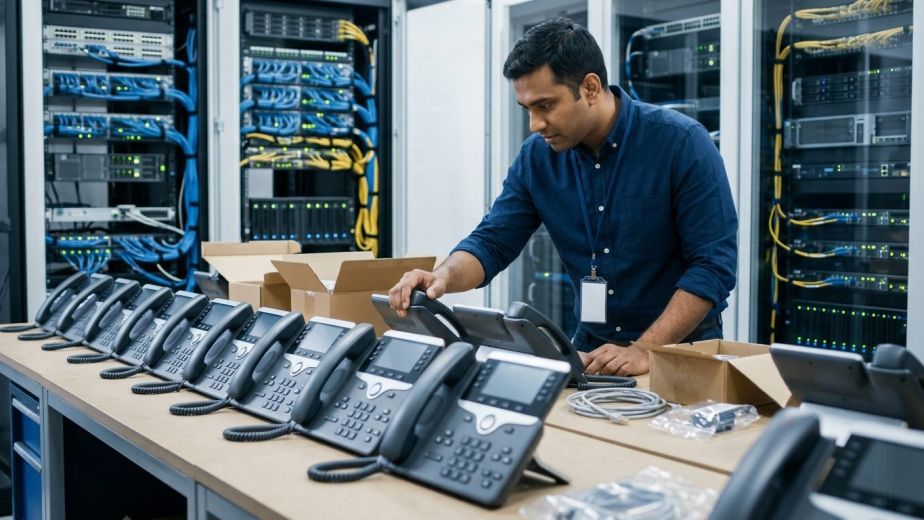
Effective pbx management ensures that enterprise voice communications remain secure, clear, and resilient across distributed office locations and hybrid workforces. Rather than treating telephony as an isolated piece of office hardware, modern businesses view voice infrastructure as a mission-critical IP application that demands active technical governance. This guide outlines how IT and operations directors can standardise daily administration, protect against voice vulnerabilities, and evaluate external service level agreements.
Key takeaways
- True telephony governance extends far beyond user setup to encompass active session border controller (SBC) security, automated trunk failover, and SIP signaling encryption.
- Proactive quality monitoring relies on tracking jitter, latency, and packet loss to maintain a high Mean Opinion Score (MOS) across all call paths.
- Disciplined staging protocols for firmware and platform patches protect voice systems from critical software bugs without disrupting business operations.
- Outsourcing to a dedicated provider eliminates internal telecom skill gaps while delivering contractual recovery times and continuous fraud mitigation.
What PBX Management Entails in Modern Voice Architecture
Modern enterprise telephony has evolved beyond the legacy physical switchboard bolted to a server room wall. Today, robust pbx management applies across software appliances, virtual instances hosted in data centres, and cloud-native systems such as 3CX and Yeastar. These platforms coordinate session initiation protocol (SIP) signalling, real-time media streams, and complex call routing rules across software clients and hardware desk phones.
Consequently, managing a phone system requires continuous oversight of three distinct architectural layers:
- The Endpoint Layer: Physical IP desk phones, conference units, and softphone applications operating across corporate laptops and mobile devices.
- The Control Layer: The central PBX software engine, session border controllers, and call routing databases that process dial plans and enforce user permissions.
- The Carrier Layer: Upstream SIP trunks, telecommunications carrier interconnects, and emergency calling gateways that route traffic to the public switched telephone network (PSTN).
When an organisation neglects any of these layers, voice quality degrades, dialling errors multiply, and unpatched endpoints become convenient targets for automated network scans.

Core Pillars of Daily VoIP PBX Administration
Day-to-day voip pbx administration involves much more than creating an account when a new employee joins the company. It requires a disciplined approach to moves, adds, changes, and deletions (MACDs) that keeps internal directories clean and routing logic efficient.
First, user provisioning should follow structured templates. When staff change roles or depart, administrators must immediately reassign digital extensions, update ring groups, and revoke device authentication credentials. Stale extensions with active external dialling rights represent an unnecessary vulnerability.
Second, inbound call flows require regular review. Multi-level Interactive Voice Response (IVR) auto-attendants must reflect current departmental structures, working hours, and holiday schedules. If an IVR directs callers down dead-end queues or plays outdated announcements, customer trust drops immediately.
Finally, hybrid and distributed work environments require unified integration. Modern administration ensures that voicemail-to-email services, CRM dialling hooks, and mobile softphone configurations synchronise reliably across desktop and mobile devices without requiring end users to adjust complex network settings.
Hardening Voice Infrastructure: PBX Toll Fraud Prevention
Telephony infrastructure faces constant scanning from automated botnets seeking unauthenticated SIP ports. Effective pbx toll fraud prevention prevents malicious actors from hijacking outbound trunks to generate thousands of calls to premium-rate foreign numbers overnight, which can leave businesses facing massive carrier bills.
Voice administrators must secure signaling ports by enforcing SIP transport layer security (TLS) and encrypting call audio using Secure Real-Time Transport Protocol (SRTP). Furthermore, the PBX management console should never sit directly on the public internet. Instead, protect administrative interfaces behind dedicated zero-trust network access (ZTNA) or corporate VPN tunnels configured through your cybersecurity solutions.
Unit 42, in its report The Noise Inside the Network: How an Unsophisticated Attack Exposed a Third-Party Risk, highlighted how unsophisticated attacks can expose wider operational risks through neglected perimeter weaknesses.
In voice systems, an exposed default password on an administrative port or an unmonitored test extension provides exactly this type of opening. Essential voice security controls include:
- Geographic Dialling Restrictions: Disable outbound dialling to foreign country codes that your organisation does not conduct legitimate business with.
- Granular Extension Permissions: Restrict out-of-hours international calling on general desk extensions and common-area phones.
- Automated Intrusion Defences: Configure real-time rate limiting and IP blacklisting to instantly drop IP addresses that fail multiple SIP registration attempts.
- Carrier Credit Caps: Establish daily spend thresholds with your upstream SIP trunk providers to halt abnormal call volume automatically before financial losses escalate.
IP PBX Monitoring, QoS, and Carrier Trunk Failover
Call clarity is highly sensitive to underlying network conditions. Routine ip pbx monitoring focuses on detecting network anomalies before they manifest as dropped calls, audio distortion, or one-way audio during important client conversations.
Engineers evaluate real-time voice health using the Mean Opinion Score (MOS), a standard defined by the International Telecommunication Union (ITU) ranging from 1 (unacceptable) to 5 (excellent). To maintain a business-grade MOS score above 4.1, network switches and routers must enforce Quality of Service (QoS) mechanisms that prioritise voice traffic across local networks.
| Metric | Target Threshold | Operational Impact if Exceeded |
|---|---|---|
| Packet Loss | < 1% | Causes audio clipping, robotic speech, and missed syllables. |
| Network Jitter | < 20 ms | Leads to jerky, uneven sound as packets arrive out of sequence. |
| One-Way Latency | < 150 ms | Creates awkward conversational delays and echo effects. |
| Mean Opinion Score (MOS) | > 4.0 | Scores below 3.6 indicate severe user dissatisfaction. |
Beyond local QoS, operational continuity depends on trunk failover design. When a primary fibre line suffers an unexpected disruption, managed voice architecture automatically shifts active registration to a secondary SIP trunk or a backup wireless connection using a managed SD-WAN link. If external connectivity drops completely, the system should instantly route incoming calls to backup mobile numbers or an alternative operations centre.
Lifecycle Governance and PBX Maintenance Checklist
A structured pbx maintenance checklist prevents the operational drift that leads to unexpected outages. Voice systems are software environments that require regular patching, certificate updates, and database maintenance to perform dependably.
Firmware management for physical desktop endpoints like Yealink and Fanvil devices requires strict governance. Pushing untested firmware directly to hundreds of office phones can break custom provisioning templates or disrupt emergency dialling. Deploy firmware updates to an isolated pilot group first, monitor performance for five business days, and only then schedule a broad rollout outside normal working hours.
Similarly, disaster recovery plans must be tested rather than assumed. Administrators should maintain an automated backup regime:
- Daily Configuration Snapshots: Store encrypted copies of system routing rules, extension maps, and IVR logic on offsite cloud storage.
- Call Detail Record (CDR) Archiving: Extract and preserve audit logs regularly to maintain compliance and support security forensics.
- Quarterly Restoration Drills: Stand up a sandbox PBX instance using the latest offsite backup to verify that Recovery Time Objectives (RTO) and Recovery Point Objectives (RPO) meet your organisation’s standards.
In-House IT Administration vs. Managed PBX Service
As enterprise communication systems integrate more closely with cloud platforms, identity providers, and unified messaging apps, managing them in-house requires specialised telecom knowledge that general IT staff rarely possess. Deciding between internal support and an outsourced managed pbx service comes down to operational risk, technical capabilities, and total cost.
| Operational Dimension | In-House IT Department | Specialised Managed PBX Partner |
|---|---|---|
| Specialist Skills | Generalist technicians balancing telecoms with helpdesk tickets. | Dedicated voice engineers certified across leading PBX platforms. |
| Coverage Windows | Typically restricted to business hours; out-of-hours coverage is costly. | Continuous 24/7 monitoring, automated alerting, and rapid triage. |
| Security & Fraud Defence | Reactive patching often delayed by competing IT priorities. | Active toll fraud monitoring, automated blacklisting, and hardened SBCs. |
| Carrier Escalations | Internal staff spend hours dealing with telecommunication carriers. | Direct provider escalation paths and carrier-grade monitoring. |
| Hardware Lifecycle | Capital expenditure cycles with unpredictable replacement costs. | Structured provisioning, lifecycle tracking, and standard staging. |
For growing mid-market organisations, handling voice internally often diverts valuable engineering talent away from revenue-generating digital projects into routine dial-plan maintenance.
Evaluating Managed Providers: Key SLA Criteria
When selecting an external partner for enterprise communications, business leaders should evaluate prospective providers on operational accountability rather than feature lists alone. Key criteria to explore include:
- Service Level Agreements (SLAs): Look for guaranteed response and resolution times tiered by business impact. A complete failure of inbound routing requires a sub-30-minute critical response, whereas a routine extension modification can follow standard turnaround windows.
- Carrier Interconnect Management: Confirm whether the provider handles technical disputes directly with upstream SIP and telecom carriers, sparing your internal team from finger-pointing during trunk outages.
- Change Management Protocols: Ensure the vendor operates under formal change control policies, meaning every dial-plan change, routing modification, and firmware rollout is logged and easily reversible.
- Periodic Security Audits: Your partner should deliver regular administrative reviews, identifying unused extensions, checking firewall ACLs, and auditing international dial permissions to guarantee compliance.
Partnering with Call Experts allows enterprises to offload the technical burden of running mission-critical voice environments. By applying proactive engineering, strict security policies, and continuous monitoring, organisations can focus on their core operations while enjoying clear, dependable communication across all their locations.
Ensure Resilience with Professional PBX Management
Voice communications remain the backbone of customer service, high-value sales, and critical business continuity. Treating your phone system as an unmonitored utility leaves your network open to toll fraud, frustrating call quality drops, and extended downtime when network links fail. Establishing robust operational controls, strict patching schedules, and clear SLAs ensures your voice infrastructure consistently supports your wider business objectives.
To modernise your voice infrastructure, resolve persistent quality problems, or explore fully managed communications tailored to your operational requirements, speak with the voice specialists at Call Experts through our contact page today.
Frequently asked questions
What is the primary difference between PBX administration and PBX management?
PBX administration typically focuses on basic moves, adds, changes, and user extensions. PBX management is a broader operational discipline that includes SBC security hardening, automated SIP trunk failover, QoS network monitoring, firmware lifecycle governance, and toll fraud prevention.
How do administrators prevent toll fraud on business telephone systems?
Toll fraud is prevented by disabling international dialling on unnecessary extensions, applying automated IP blacklisting, hiding administrative consoles behind VPNs, and setting daily financial thresholds with upstream SIP carriers to stop unauthorized call bursts.
What network metrics determine business VoIP call quality?
Voice quality depends on four core network metrics: packet loss (should remain below 1%), network jitter (under 20 ms), one-way latency (under 150 ms), and the resulting Mean Opinion Score (MOS, targeted above 4.1).
How often should enterprise PBX systems and IP desk phones be updated?
Security patches and minor PBX software updates should be reviewed monthly, while major releases follow quarterly cycles. Physical desk phone firmware should always be validated in an isolated staging group before broad deployment.
Sources
- The Noise Inside the Network: How an Unsophisticated Attack Exposed a Third-Party Risk — Unit 42, 2026-10-13